
The data to be recorded in the case of the oil and gas fields mudslides project would first have to be judged separately from vehicle traffic, stationing of equipment and support for the suspension. In the muddy areas between oil wells, gas wells, distribution stations and service vehicles, the topic concerns “what data should be recorded in the case of the oil field and gas field mud lanes” which usually follows multiple stages of entry, construction, overhaul and evacuation, and changes in ground water content and traffic. What is most likely to be overlooked on this topic is that the repeated traffic of vehicles forms a deep path and destroys the grass roots. The problem of grass-roots and drainage may have expanded if only ad hoc slabs were added after a vehicle has been trapped.
One-time collection of oil or gas well locations, service vehicle types, full axle loads, road soft points, rainfall, traffic frequency, operating class, pollution control and emergency routes is recommended prior to design and request. The topic could begin with a programme of “reversely dismantling and retaining emergency routes in the order in which equipment is withdrawn”. The standard 15, 20, 25 and 30 mm specifications for paving boards can only be used as the starting point for communication, with the actual selection being combined with materials, size, thickness, single weight, texture, connection, grass-roots support and supplier testing conditions. For “what data should be recorded in the case of the oil and gas fields mud-traffic project”, the information review should also indicate in the request for quotation documents the use, quantity, duration, packaging and port of destination, and include missing information as items to be confirmed in the quotation and construction programme.
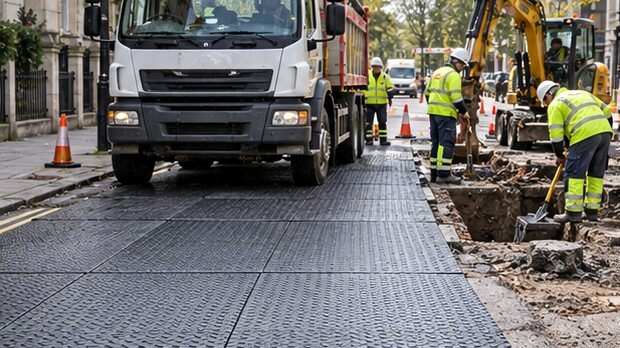
Figure: Mud areas between oil wells, gas wells, distribution stations and service vehicles, with a focus on “What data should be recorded in the case of the oil field and gas field mud tunnel project” (inventory material for the plastic network).
Pre-implementation should be preceded by the containment of routes, the removal of sharp stones, stakes and miscellaneous items that may form a spot load, the repair of deep-pit tracks and the removal of horizontal drainage. The muddy oil and gas field road should first cut the drain and repair the deep-drive tracks, and then use the continuous laying of dispersed wheels, so that the plates cannot be thrown directly into the flow of thin mud. The plates should be prepared continuously at the stabilization end, with the bends, reverses and parking areas being expanded as appropriate; the leg mats should be flat, intermediated and in full contact, and it should not be allowed to be filled with random stacking. The trial-past record of the “Data to be recorded in the case of the oil field and gas field mud tunnel project” should identify the starting and ending position, vehicle condition and release conclusions to facilitate review following a change in construction conditions.
The shift involves reporting changes in pumping mud, water accumulation, pressure edges, slides, loose connections, pollutants, shoulder deposition and vehicle congestion, rather than just describing the appearance. The sutures, shoulders or sub-points repaired in the previous class are reviewed in the next class. In the event of repeated vehicle traffic forming a deep path and destroying the grass-roots level as traffic increases, the project should immediately limit, reroute or suspend the equipment until the re-check is passed. The inspection forms, which revolve around what data should be recorded in the case of the Oil Fields and Gas Fields mudslides Project, require the repeated movement of separate vehicles to create deep ground and disrupt changes at the grass-roots level, as well as a reference to the inspector and the time of return.
It is recommended that a key route or a feeder of equipment be selected for controlled validation, with observation cycles and exit conditions. The record should cover normal and most unfavourable conditions, with particular attention to the re-routing of vehicles and the destruction of the grass roots. A further expansion after the trial could reduce one-time procurement or full-line errors, while providing the same basis for vendor comparison. It should also answer whether “what data should be recorded in the case of the oil field and gas field mud tunnel project” has been improved by the reverse removal and retention of the emergency route in the order in which the equipment was withdrawn, and at the end of the day, to avoid a subjective description of the final item.
Road-painting and foot mats can only function in the approved construction system and cannot be a substitute for unsatisfactory foundations, damaged equipment or irregularities. Any unknown underground facility, unstable edges, legwork beyond the equipment manual or failure to isolate persons should be suspended and upgraded.
The following special verifications should be carried out in relation to the mud zone between oil wells, gas wells, distribution stations and service vehicles, “what data should be recorded in the case of the oil field and gas field mud tunnel project”, in conjunction with the following special verifications: the case records should cover pre-entry conditions, product batches, layout, vehicle cycle, weather, anomalies, maintenance, demolition and restoration results. The next option could not be supported by a record of smooth traffic, and restrictions and the missing link must be retained.
On-site implementation of recommendations: Case findings should identify both success and failure conditions, such as ground improvement, speed limit, traffic and weather windows. Only if these borders are retained will the next project not misperceive a specific site result as a universal undertaking.
Need for further evaluation of the actual project?
Applications, sizes, quantities, site photographs or drawings and delivery destinations are sent, on which we can identify more suitable products and processing programmes.







