
The objective of the availability of spare panels for ground protection of drilling equipment is to allow construction vehicles to move within the controlled route, while avoiding turning ground protection issues into equipment stabilization problems. With regard to the construction of the rig, the relocation of equipment, the supply of materials and the auxiliary sling site, the subject concerns “the number of spare panels for the protection of the well-drilled equipment on the ground” should be checked, inter alia, for the secondary crushing and restoration costs resulting from the incorrect sequence of the evacuation site. Where there is a gutter, backfilling area, slope or unknown underground facility on the route, the treatment must first be confirmed by the responsible party of the project.
The focus of the topic is not on the choice of the thickest or the most heavy products, but on the establishment of a match. The coverage, connection and back-up levels are determined by continuous coverage according to the most unfavourable vehicle, complete wheel and weather change planning, based on the weight of the rig module, the axle load of the transport vehicle, the size of the belt, the retroactivity of the crane leg, the equipment set-up, the underground facility, the field endurance and the changes in the rainy season. In the case of products requiring cross-project turnaround, the numbering, loss rate, cleaning time and volume of transport should also be included in the total cost. For “how many back-up panels are required for ground protection of drilling equipment”, the information review should also include snow, ice, sand and tyre state in towed management at the same time, and include missing information as an item to be confirmed in the quotation and construction programme.
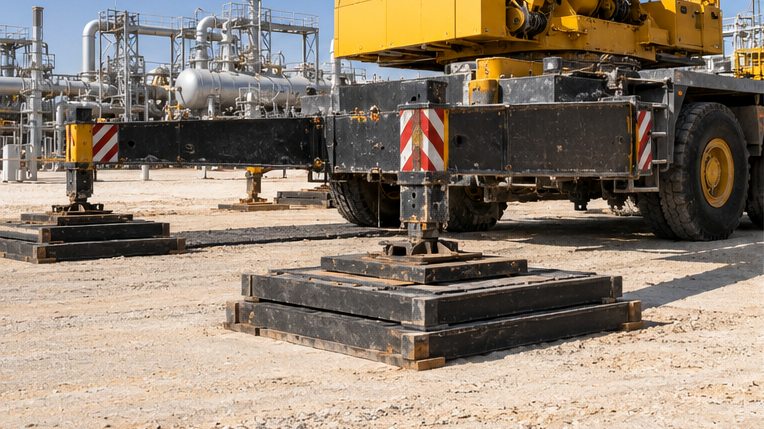
Figure: rig construction, equipment relocation, supplies and auxiliary hang-up sites, with a focus on “How many back-up panels will be required for surface protection of drilling equipment”
A smooth transition should be put in place at the different ground crossings to avoid the sudden impact of vehicles on temporary circuits from hard roads. The internal and external wheels and brake locations of the most heavy vehicles will be reviewed after successive coverage has been completed in accordance with the most unfavourable vehicle, complete wheel and weather change planning. The rigs shall distinguish between vehicle access, stationing of equipment and cranes, and the pavement shall be responsible for the protection of the ground and the mats shall be accounted for on the basis of maximum reversibility and durability. Physical segregation and clear rules for release are required in the vicinity of public areas. The trial-pail record of “how many back-up panels will be prepared for surface protection of drilling equipment” should indicate the starting-point location, vehicle condition and release conclusions to facilitate review as construction conditions change.
Multi-shift or lease items may record the track track, the permanent deformation of the sheet, the sinking of the legs, the drainage of the floor, soft spots, connectors, mud contamination and level, and link road maps and product numbers. Continuous anomalies should trigger a review of the project, rather than a mere surface. Visible permanent deformation, deep mouth or postpoint damage to the leg cushions shall be judged by standard manufacturer ' s isolation. With regard to “the availability of spare panels for the ground protection of drilling equipment”, the patrol forms are to be marked in a separate series of errors in the order of the evacuation field, resulting in a change in the secondary crushing and recovery costs and an indication of the inspector's return time.
A reset is to distinguish between product problems and changes in condition. The original programme may no longer be appropriate if the vehicle is heavy, routed, rainfall increases or cover periods are extended. These changes are recorded with the results of the implementation of the successive coverage according to the most adverse vehicle, complete wheel and weather change planning, and it is only next to know whether the thickness, width, quantity or construction organization should be adjusted. This repertoire should also answer whether “the availability of back-up panels for the protection of well-drilled equipment on the ground” has been demonstrated to be improved through continuous coverage according to the most adverse vehicle, complete wheel and weather change planning, avoiding a subjective description only.
If the conditions on the ground are different from the assumptions in this paper, the application of the conclusions should be suspended and reassessed. Fuel and gas transport, suspension, recovery and repair are subject to the project programme, equipment manual and statutory requirements. The supplier may assist in matching the product, but the final placement, commissioning and release shall be approved by the responsible party for the project.
The following special verification should be carried out in connection with the construction of the rig, the relocation of the equipment, the supply of materials and the auxiliary sling site, as well as with respect to “the number of spare panels required for the ground protection of drilling equipment”, as follows: the back-up quantity should be calculated in conjunction with the length of the route, the key nodes, the projected rate of damage, the cleaning lead time and the replenishment distance. Remote projects cannot be purchased on a net-painted basis only, and authorized stocks should be reserved for soft-point expansion, loss of connections and temporary rerouting.
On-site implementation of the recommendation: The back-up plate should be close to key soft points without access to emergency routes and counted with connectors, tractors and cleaning materials. The inventory should distinguish between quantities that can be used immediately, that are to be cleaned, that are to be assessed and that are scrapped.
Need for further evaluation of the actual project?
Applications, sizes, quantities, site photographs or drawings and delivery destinations are sent, on which we can identify more suitable products and processing programmes.







