
At the site of the drilling rig, the relocation of equipment, the supply of materials and the auxiliary suspension, the subject concerns “the need to select thick pavements for the protection of the well-drilling equipment on the ground” and the fact that the surface appears flat does not mean that there is a continuous burden under the board. The surface protection of drilling equipment requires the choice of thick pavements, and the condition of the ground, weather and the most heavy vehicles should be recorded before entering the field, as different test conditions directly compare the miscalculations caused by the nominal tonnage may occur after repeated traffic. The establishment of baseline photographs and measurement points will facilitate follow-up inspections and recovery of acceptances.
The technical communication should first identify the control design of the driller module, the transport vehicle axial load, the tracked size, the retroactivity of the crane leg, the equipment set-up, the underground facility, the site endurance and the conditions of the rainy season. It is proposed that approved road maps, serial numbers and inspection records be used to manage on-site changes and that suppliers be asked to describe the materials for the pavement or leg pads, the grade of the finished product, the test method, the basis for application and the conditions of limitation. Reference data such as nominal 50 to 200 tonnes cannot be directly compared horizontally without the same test basis. For “the selection of thick pavements for ground protection of drilling equipment”, the information review should also set fixed observation points on the outside side of the shoulder, slope and turn and include missing information as an item to be confirmed in the quotation and construction programme.
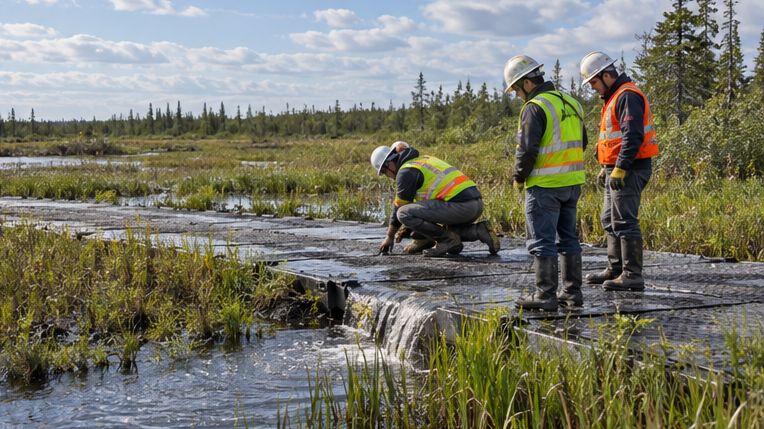
Figure: rig construction, equipment relocation, supplies and auxiliary hang-up sites, with a focus on “How thick a pavement is needed for the protection of well-drilling equipment on the ground”
Pre-implementation should be preceded by the containment of routes, the removal of sharp stones, stakes and miscellaneous items that may form a spot load, the repair of deep-pit tracks and the removal of horizontal drainage. The rigs shall distinguish between vehicle access, stationing of equipment and cranes, and the pavement shall be responsible for the protection of the ground and the mats shall be accounted for on the basis of maximum reversibility and durability. The plates should be prepared continuously at the stabilization end, with the bends, reverses and parking areas being expanded as appropriate; the leg mats should be flat, intermediated and in full contact, and it should not be allowed to be filled with random stacking. The test-pail record of “the surface protection of drilling equipment requires the selection of thick pavements” should indicate the starting and ending position, vehicle condition and release conclusions to facilitate review as construction conditions change.
The track tracks, the permanent deformation of the plate, the deposition of legs, the drainage of the floor, soft spots, connections, mud contamination and levels shall be checked before classes, after peak traffic and after rainfall. Each record shall contain the date, location, vehicle, weather, unusual photographs and processing results. In the case of repeated tests in the same region with different conditions but with a direct comparison of the nominal tonnage resulting in miscalculation, it should go back to the grass-roots, drainage, transport organization and specification re-analysing rather than replacing only surface components. With regard to the “well-drilling equipment ground protection requiring the choice of thick pavements”, the inspection forms need to be presented in a separate series of test conditions, but directly compared to the nominal tonnage, resulting in a miscalculation change and a reference to the inspector and the time of return.
The impact assessment cannot be based solely on the movement of vehicles on the same day. The project compares vehicle waiting, trapping, maintenance hours, cleaning time, loss of connection, site restoration area and evacuation cycle, and records weather and traffic simultaneously. The question of whether this option is suitable for replication at the next hydrocarbon project is determined by the creation of data based on different test conditions, but directly comparing the data with the miscalculated tonnage. This repertoire should also answer whether “the surface protection of drilling equipment requires the choice of thick pavement boards” has been certified for improvement through the management of on-site changes using approved road maps, numbers and inspection logs, so as to avoid the closure of the item with only subjective descriptions.
This topic can be summarized as first confirming the boundary of the work, then configure the appropriate product, and then validate it with test run, inspection and project data. The formal programme should identify those responsible, the restrictions, the criteria for decommissioning, the means of recovery and the emergency route, so as to avoid the loss of critical information following changes in the class or contractor.
In response to “the need to select thick pavements for surface protection of drilling equipment”, the following special verifications should be carried out in conjunction with the drilling platform, the relocation of equipment, the supply of materials and the auxiliary suspension site: the selection of thickness should take into account also materials, panel structures, dimensions, continuous support at the grass-roots level, temperature, type of vehicle and means of connection. 15, 20, 25 or 30 mm may be used as an option for quotations, provided that the final recommendation indicates the assumptions, the basis of the test and the circumstances of the work not applicable.
On-site implementation of the recommendation: The same thickness may be different under different dimensions, material formulations, texture and supporting conditions. The sample assessment should measure the actual thickness and weight and require suppliers to explain the test method, allow deformation and product use limits.
Need for further evaluation of the actual project?
Applications, sizes, quantities, site photographs or drawings and delivery destinations are sent, on which we can identify more suitable products and processing programmes.







