
Land protection of drilling equipment compares with different suppliers, starting with the separation of vehicle traffic, stationing of equipment from the support of cranes. With regard to the construction of drilling platforms, the relocation of equipment, the supply of supplies and the auxiliary hang-up sites, the topic focuses on how “ground protection of drilling equipment compares with different suppliers” usually follows multiple stages of entry, construction, overhaul and evacuation, with variations in ground water content and traffic. The issue is most easily ignored when the test conditions differ and the nominal tonnage is directly compared to the miscalculated. The problem of grass-roots and drainage may have expanded if only ad hoc slabs were added after a vehicle has been trapped.
A one-time collection of the rig ' s weight, transport vehicle axle loads, tracked sizes, retrogressive legs of the crane, equipment set-up, underground facilities, site endurance and changes in the rainy season are recommended before design and request for price. The subject could begin with a programme “Managing on-site changes with approved road maps, numbers and inspection records”. The standard 15, 20, 25 and 30 mm specifications for paving boards can only be used as the starting point for communication, with the actual selection being combined with materials, size, thickness, single weight, texture, connection, grass-roots support and supplier testing conditions. For “how to compare different suppliers for ground protection of drilling equipment”, the information review should also be carried out in the order in which the last equipment was to be removed and loaded in reverse along the exit route, and the missing information should be included as an item pending confirmation of the offer and the construction programme.
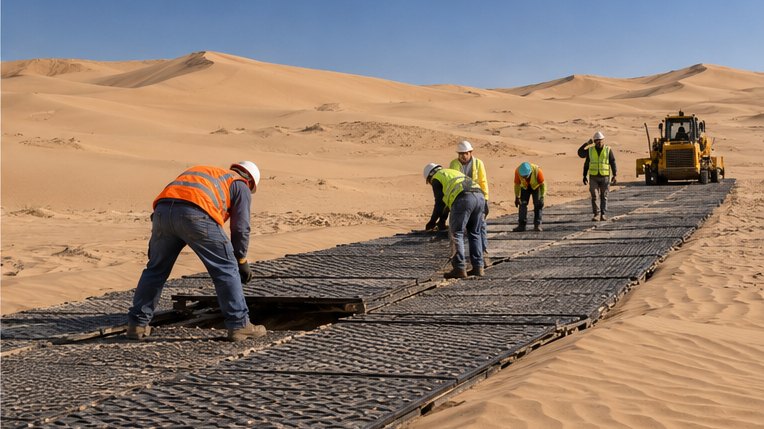
Figure: rig construction, relocation of equipment, supply of materials and auxiliary suspension sites, with a focus on “how to compare different suppliers for ground protection of drilling equipment”
In the absence of space on the ground, work cannot be undertaken by reducing the necessary cover or moving legs to the shoulder of the road. Stations and construction should be reordered to provide sufficient space for “managing on-site changes with approved road maps, numbers and inspection records”. The rigs shall distinguish between vehicle access, stationing of equipment and cranes, and the pavement shall be responsible for the protection of the ground and the mats shall be accounted for on the basis of maximum reversibility and durability. Any forced overlays of holes, temporary mats or uncounted should be returned to the technical manager for evaluation. The trial-pail record of “how to compare the ground protection of drilling equipment with different suppliers” should indicate the starting and ending position, vehicle status and release conclusions to facilitate review as construction conditions change.
Special inspections should be added after extreme weather, equipment anomalies or route adjustments. Use of position markings and fixed view photographs for track tracks, permanent deformation of the plate, leg deposition, courtyard drainage, soft spots, connectors, mud contamination and horizontal levels to facilitate comparison of sedimentation and shift. Cleaning the surface of polymers avoids fire, sharp shovels and violent knocks, creating new cracks and stress concentrations. Around “how to compare different suppliers for ground protection of drilling equipment”, the inspection forms need to show a separate list of test conditions, but a direct comparison of the nominal tonnage results in a miscalculation change, with an indication of the inspector and the time of return.
The impact assessment cannot be based solely on the movement of vehicles on the same day. The project compares vehicle waiting, trapping, maintenance hours, cleaning time, loss of connection, site restoration area and evacuation cycle, and records weather and traffic simultaneously. The question of whether this option is suitable for replication at the next hydrocarbon project is determined by the creation of data based on different test conditions, but directly comparing the data with the miscalculated tonnage. It should also answer whether the “how to compare the ground protection of drilling equipment with different suppliers” has been demonstrated by using approved road maps, numbering and inspection logs to manage site changes to avoid a subjective description of the closure.
Road-painting and foot mats can only function in the approved construction system and cannot be a substitute for unsatisfactory foundations, damaged equipment or irregularities. Any unknown underground facility, unstable edges, legwork beyond the equipment manual or failure to isolate persons should be suspended and upgraded.
With regard to “how to compare different suppliers for ground protection of drilling equipment”, the following special verifications should be carried out in conjunction with the drilling platform, the relocation of equipment, the supply of materials and the auxiliary suspension site: when comparing suppliers, the material, size, thickness, surface texture, connection, test conditions, packaging and trade boundaries should be harmonized. If the offer is given only to the maximum carrying number and there is a lack of distance, foundation and loading, the information should be completed and reviewed.
On-site implementation of recommendations: In addition to product data, suppliers should review the feedstock control, size testing, batch retroactive, packaging and abnormal processes. Samples should be consistent with the materials and processes of the bulk product and allow deviations in the order.
Need for further evaluation of the actual project?
Applications, sizes, quantities, site photographs or drawings and delivery destinations are sent, on which we can identify more suitable products and processing programmes.







