
The case of the ground protection project for drilling equipment should record which data should start from the most unfavourable rather than the average. With regard to the construction of drilling platforms, the relocation of equipment, the supply of materials and the auxiliary hang-up sites, the focus of the topic is on what data should be recorded in the case of the ground protection project for drilling equipment, which may be affected by heavy vehicle cycles, rainfall and time compression at the same time, with static, brakes and turnovers resulting in a significant increase in local pressure as traffic is increased. It would be clearer for on-site execution to first determine the conditions for allowing deposition, decommissioning and those responsible, and then select product specifications.
The product configuration cannot be determined by area or thickness alone. The project shall verify the weight of the driller module, the axle load of the transport vehicle, the size of the belt, the retroactivity of the crane leg, the equipment set-up, the underground facility, the field endurance and changes in the rainy season, and then convert the static, brake and turnover to a significant increase in local pressure into drainage, carrying, stabilization, surface pull and restoration requirements. Moving tools, manual weights, back-up quantities, cleaning and back-to-back stacking are also considered in connection with the presentation of work profiles, test bases and qualifications in the request and acceptance documents. For “data to be recorded in the case of the ground protection project for drilling equipment”, the information review should also indicate the purpose, quantity, duration, packaging and port of destination in the request for quotation documents and include missing information as an item to be confirmed in the quotation and construction programme.
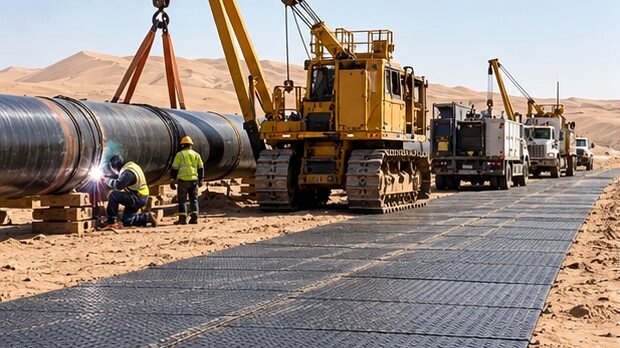
Figure: rig construction, equipment relocation, supplies and auxiliary hang-up sites, with a focus on “what data should be recorded in the case of the ground protection project for drilling equipment” (inventory material for the plastic network).
The installation should leave a photo, location and measurement record. First, ground-level levelling, drainage and underground facilities are identified, and the complete contact, connection, edge and transition of the pavement is checked, or the size, location and centering of the leg pads are checked. The rigs shall distinguish between vehicle access, stationing of equipment and cranes, and the pavement shall be responsible for the protection of the ground and the mats shall be accounted for on the basis of maximum reversibility and durability. Areas not eligible for acceptance should not be replaced by speed-limit signs alone. The trial preparation records of “the data to be recorded in the case of the ground protection project for drilling equipment” should identify the starting and ending position, vehicle condition and release conclusions to facilitate review as construction conditions change.
The track tracks, the permanent deformation of the plate, the deposition of legs, the drainage of the floor, soft spots, connections, mud contamination and levels shall be checked before classes, after peak traffic and after rainfall. Each record shall contain the date, location, vehicle, weather, unusual photographs and processing results. In the case of repeated static, brakes and turnovers in the same region, which significantly increase local stress, it should return to the grass-roots, drainage, transport organization and specification re-analysing rather than replacing surface components only. With regard to what data should be recorded in the case of the Ground Protection Project for drilling equipment, the inspection forms need to show separately changes in static, brakes and turnovers that significantly increase local stress, and to indicate the time taken by the inspector and his/her return.
Construction, logistics, HSE, equipment, site and procurement could be jointly evaluated before the planned expansion. The parties confirm the conditions of passage, suspension, inspection, restoration and delivery, to verify whether the conditions of work, the basis of testing and the conditions of delivery are actually enforceable in the request for and acceptance documents. The results of the review should be included in the programme rather than in oral communication. It should also answer whether the “data to be recorded in the case of the ground protection project for drilling equipment” has been validated and improved by placing a description of the work, the basis of testing and the conditions of limitation in the request and acceptance documents, so as to avoid a subjective description of the closing item.
Progress pressure cannot reduce the security floor. When static, brakeing and turnovers significantly increase local pressure, they should first isolate and identify the reasons before deciding on the repair, diversion or replacement of the product. Any measures should avoid introducing new risks of slide, overloading, tripping, electric area intrusion or human-car conflict.
The following special verification should be carried out in connection with the construction of the rig, the relocation of the equipment, the supply of materials and the auxiliary suspension site in the case of the “ground protection project for drilling equipment”, as follows: the case record should cover pre-entry conditions, batches of products, drawings, vehicle cycle, weather, anomalies, maintenance, demolition and restoration results. The next option could not be supported by a record of smooth traffic, and restrictions and the missing link must be retained.
On-site implementation of recommendations: Case findings should identify both success and failure conditions, such as ground improvement, speed limit, traffic and weather windows. Only if these borders are retained will the next project not misperceive a specific site result as a universal undertaking.
Need for further evaluation of the actual project?
Applications, sizes, quantities, site photographs or drawings and delivery destinations are sent, on which we can identify more suitable products and processing programmes.







