
The objective of stabilizing access for utility vehicles on the roadside slopes is to allow construction vehicles to move within controlled routes, while avoiding turning ground protection into equipment stabilization. With regard to construction sites for utilities such as water supply, drainage, gas and municipal pumping stations, the topic is “How to stabilize the flow of public utility vehicles on the roadside”, and special checks should be made for loose connections, drainage congestion or pollution to reduce actual usage. Where there is a gutter, backfilling area, slope or unknown underground facility on the route, the treatment must first be confirmed by the responsible party of the project.
The technical communication should first confirm which of the control designs of the full load of the vehicle, the green land conditions of the city, the location of the roots and pipes, public access, the hours of operation, the reverse space and site restoration criteria are to be used. It is proposed that continuous coverage be planned on the basis of the most disadvantaged vehicles, complete wheels and weather changes, and that suppliers be requested to describe the materials for the pavement or leg pads, the grade of finished products, the method of testing, the basis of application and the conditions of limitation. Reference data such as nominal 50 to 200 tonnes cannot be directly compared horizontally without the same test basis. For “how to stabilize the flow of utility vehicles on the roadside”, the information review should also calculate the area covered by the line, the bend, the meeting and the reverse areas, respectively, and include missing information as items to be confirmed in the quotation and construction programme.
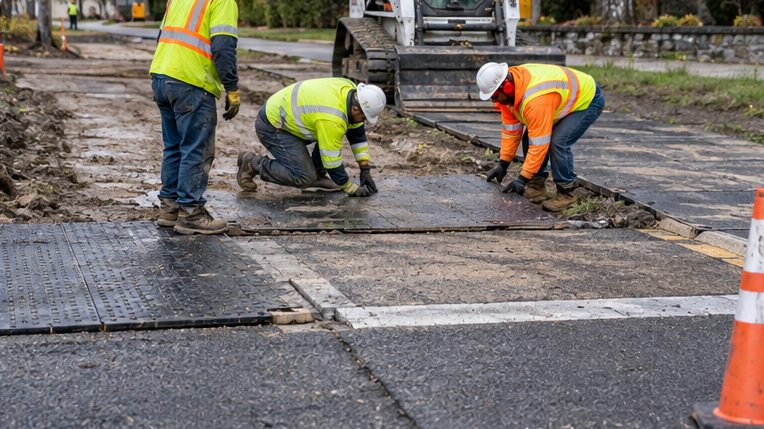
Figure: Public utility construction sites such as water supply, drainage, gas and municipal pumping stations, with a focus on “how to stabilize the flow of public utility vehicles on roadside slopes”
The installation should leave a photo, location and measurement record. First, ground-level levelling, drainage and underground facilities are identified, and the complete contact, connection, edge and transition of the pavement is checked, or the size, location and centering of the leg pads are checked. Construction of utilities is often adjacent to the public and established facilities, and temporary access must be accompanied by carrying, isolation, accessibility and rapid recovery requirements. Areas not eligible for acceptance should not be replaced by speed-limit signs alone. Test-painted records of “how to stabilize the flow of utility vehicles on the roadside” should indicate the starting point, the condition of the vehicle and the findings of release, so as to facilitate review as construction conditions change.
Special inspections should be added after extreme weather, equipment anomalies or route adjustments. The use of location markings and fixed view photographs for pedestrian boundaries, plate contamination, asphalt transitions, root areas, backfill areas, shoulder, leg positions and night lighting facilitates comparison of sedimentation and place shifting. Cleaning the surface of polymers avoids fire, sharp shovels and violent knocks, creating new cracks and stress concentrations. In the “how to stabilize the flow of utility vehicles on roadside slopes”, the patrol forms need to include a separate list of the changes in the physical state of use resulting from loose connections, drainage congestion or pollution, as well as an indication of the inspector and the time of return.
Construction, logistics, HSE, equipment, site and procurement could be jointly evaluated before the planned expansion. The parties confirm the conditions of movement, suspension, inspection, restoration and delivery to verify whether the continuous coverage according to the most disadvantaged vehicle, complete wheel and weather change planning is truly enforceable. The results of the review should be included in the programme rather than in oral communication. It should also answer whether the “stabilization of roadside utility vehicles” has been demonstrated by continuous coverage according to the most unfavourable vehicle, complete wheel and weather change planning, avoiding a subjective description alone.
Progress pressure cannot reduce the security floor. In the event of a loose connection, drainage congestion or pollution that reduces the physical condition of use, the decision should be made to repair, reroute or replace the product after isolation and identification of the cause. Any measures should avoid introducing new risks of slide, overloading, tripping, electric area intrusion or human-car conflict.
Need for further evaluation of the actual project?
Applications, sizes, quantities, site photographs or drawings and delivery destinations are sent, on which we can identify more suitable products and processing programmes.







