
The way in which roads are paved for remote energy projects is to be judged first and foremost by the separation of vehicle traffic, stationing of equipment from the support of the crane. Wind, voltage and other energy project camps, far from hard roads, focus on “How far-flung energy project pavements are rotated” usually going through multiple stages of entry, construction, overhaul and evacuation, with variations in ground water content and traffic. The most easily overlooked aspect of this topic is the lopsided or uneven deposition of points to change the level of equipment. The problem of grass-roots and drainage may have expanded if only ad hoc slabs were added after a vehicle has been trapped.
Procurement staff shall submit site maps, vehicle schedules and transportation distances, terrain, snow and snow seasons, maximum vehicle, camp layout, handling equipment, stock rotation, supply cycle and destination port to the request for quotations, and indicate the location where the level of equipment may be altered by misloading or uneven deposition at the point of payment. The programme could be based on the setting of speed limits, the prohibition of in situ rounding and the placement of dedicated commands for heavy vehicles. For the whole container procurement, the quantity of the container, the pallet or bundle, the offloading equipment, the destination port and the conditions of storage at the site should also be confirmed in advance. The information review should also distinguish vehicles by axle and tyre, replace all inputs with the total weight, and include missing information as an item to be confirmed in the quotation and construction programme.
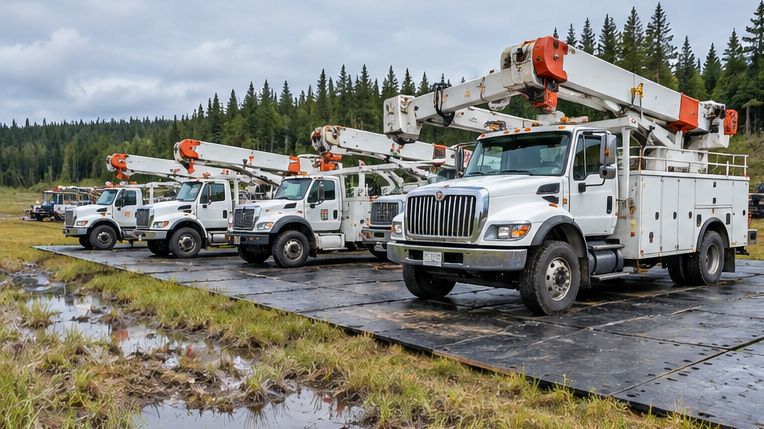
Figure: Camps for wind, photovoltaic and other energy projects, far from hard roads, with a focus on “How remote energy project pavements can be rotated”
The site installation should be located with an approved drawing number, and the level, seam, edge and drainage should be inspected at each stage of completion. Remote projects need to use roads, parking, stacks and emergency routes as a logistics system, and single-form product weights are as important as recovery efficiency. The test operation can first be carried out using a low-risk vehicle with a slow-speed straight-line and then gradually verify the turnover, parking and full-loading; it should be discontinued as soon as it is discovered that it continues to sink under the plate, pump mud or branch position. A test-painted record of “how the pavement boards of remote energy projects are rotated” should indicate the starting point, vehicle status and release conclusions to facilitate review as construction conditions change.
Special inspections should be added after extreme weather, equipment anomalies or route adjustments. The number of stockpiles, route continuity, drainage, shoulders, pollution, plate numbering, net empty location tags for handling safety and emergency vehicles and fixed view photographs allow for comparison of deposition and migration. Cleaning the surface of polymers avoids fire, sharp shovels and violent knocks, creating new cracks and stress concentrations. The inspection form, around “how the road pavement of remote energy projects is rotated”, requires a single column to overload or even downfall changes in the level of the equipment and to indicate the inspector's return time.
Construction, logistics, HSE, equipment, site and procurement could be jointly evaluated before the planned expansion. The parties confirmed the conditions of passage, suspension, inspection, recovery and delivery to verify whether the speed limit, the prohibition of in situ wheeling and the placement of exclusive command for heavy vehicles were truly enforceable. The results of the review should be included in the programme rather than in oral communication. It should also answer whether the “how far-flung energy project pavements are rotated” can be verified for improvement by setting speed limits, prohibiting in situ wheeling and arranging for exclusive command of heavy vehicles, so as to avoid a subjective description of the completion of the project.
If the conditions on the ground are different from the assumptions in this paper, the application of the conclusions should be suspended and reassessed. Energy transport, suspension, refurbishment and overhaul are subject to project programmes, equipment manuals and statutory requirements. The supplier may assist in matching the product, but the final placement, commissioning and release shall be approved by the responsible party for the project.
Need for further evaluation of the actual project?
Applications, sizes, quantities, site photographs or drawings and delivery destinations are sent, on which we can identify more suitable products and processing programmes.







