
In the case of public utility construction sites such as water supply, drainage, gas and municipal pumping stations, the focus of the topic is on “how to transition between public utility construction and asphalt roads”. With regard to the transition between the construction panels for utilities and the asphalt road, the condition of the ground, the weather and the most heavy vehicle condition should be recorded before entering the site, as the lack of information leads to a mismatch between specifications and quantities and the conditions on the ground that may occur after repeated traffic. The establishment of baseline photographs and measurement points will facilitate follow-up inspections and recovery of acceptances.
The product configuration cannot be determined by area or thickness alone. The project should verify vehicle load weights, urban green land conditions, root and pipe locations, public access, operational hours, back-of-the-car space and site restoration standards, and then convert the lack of information to specifications, quantity and incompatibilities with field conditions to drainage, carrying, stabilization, surface pull and restoration requirements. Moving tools, manual weights, back-up quantities, cleaning and back-to-back stacking are also considered in connection with the presentation of work profiles, test bases and qualifications in the request and acceptance documents. The information review should also check the continuity of lighting, reflective boundary and night differential records and include missing information as items to be confirmed for quotations and construction proposals.
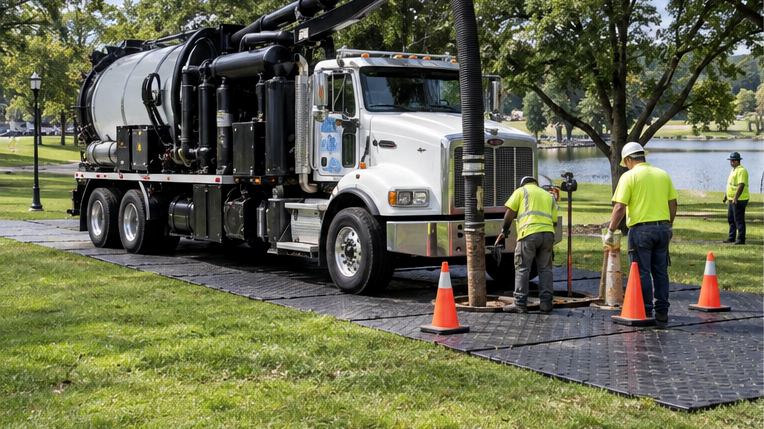
Figure: Public utility construction sites such as water supply, drainage, gas and municipal pumping stations, with a focus on “how to transition between public utility construction boards and asphalt roads”
A smooth transition should be put in place at the different ground crossings to avoid the sudden impact of vehicles on temporary circuits from hard roads. The internal and external wheels and brake positions of the most heavy vehicles will also be reviewed upon completion of the laying of the condition, test basis and restrictions contained in the request and acceptance documents. Construction of utilities is often adjacent to the public and established facilities, and temporary access must be accompanied by carrying, isolation, accessibility and rapid recovery requirements. Physical segregation and clear rules for release are required in the vicinity of public areas. The trial-pail record of the “how to make a transition between a public utility construction plate and a asphalt road” should indicate the starting and ending position, vehicle status and release conclusions to facilitate review as construction conditions change.
Inspections should not only be “normal” and should be identified on a case-by-case basis around pedestrian boundaries, plate contamination, asphalt transitions, root areas, backfill areas, shoulders, legs positions and night lighting, and be divided into three levels of observation, restriction and decommissioning. A fixed photo angle and measurement benchmark should be set for the key points that form the job, the test basis and the qualification in the request and acceptance documents. A loose connection, a permanent deformation, a breach through or a deviation of a branch shall be immediately isolated. With regard to the “how to make the transition between the public utility construction panels and the asphalt roads”, the inspection forms need to show a separate column of information leading to variations in specifications, quantities that do not match the situation on the ground, and to indicate the inspector and the time of return.
It is recommended that a key route or a feeder of equipment be selected for controlled validation, with observation cycles and exit conditions. The records are to cover normal and most unfavourable conditions, with particular attention to the fact that insufficient information leads to a mismatch between specifications and quantities on-site. A further expansion after the trial could reduce one-time procurement or full-line errors, while providing the same basis for vendor comparison. This retrodiscussion should also answer whether the “how to make the transition between the construction panels of the utility and the asphalt road” has been demonstrated to improve by including in the request for and acceptance documents a description of the work, the test basis and the conditions of the test, so as to avoid a subjective description of the closing item.
If the conditions on the ground are different from the assumptions in this paper, the application of the conclusions should be suspended and reassessed. Energy transport, suspension, refurbishment and overhaul are subject to project programmes, equipment manuals and statutory requirements. The supplier may assist in matching the product, but the final placement, commissioning and release shall be approved by the responsible party for the project.
Need for further evaluation of the actual project?
Applications, sizes, quantities, site photographs or drawings and delivery destinations are sent, on which we can identify more suitable products and processing programmes.







