
Answer how many times the pavement is used to track fixed numbers that are not off site. In the interim road demolition, cleaning, recycling and site delivery phase of the energy project, the topic is concerned about how “the number of re-uses of pavements is tracked” affected by weather, terrain, vehicle and organizational patterns, and the fact that secondary crushing and restoration costs are increased as a result of the incorrect sequence of the evacuation sites is only a visible result. The project should mark the soft spots, slopes, drainage, underground facilities and vehicle tracks on a single map to bring technology, construction, HSE and procurement data into line.
The procurement staff shall submit the site maps, vehicle schedules and pre-entry photographs, area of coverage, time of use, weather, vehicle cycle, sequence of demolition, cleaning conditions, damage rate and acceptance criteria along with the request for quotations, and indicate the location where the secondary crushing and restoration costs may have increased as a result of an error in the order of the evacuation site. The programme could be based on the reverse removal of the equipment in the order in which it was withdrawn and the retention of the emergency route to the end of the zoning. For the whole container procurement, the quantity of the container, the pallet or bundle, the offloading equipment, the destination port and the conditions of storage at the site should also be confirmed in advance. For the “how to track the number of repeats of pavements”, the information review should also distinguish between vehicles by axle-load and tyre, not replacing all inputs with the total weight, and include missing information as an item for confirmation of quotations and construction programmes.
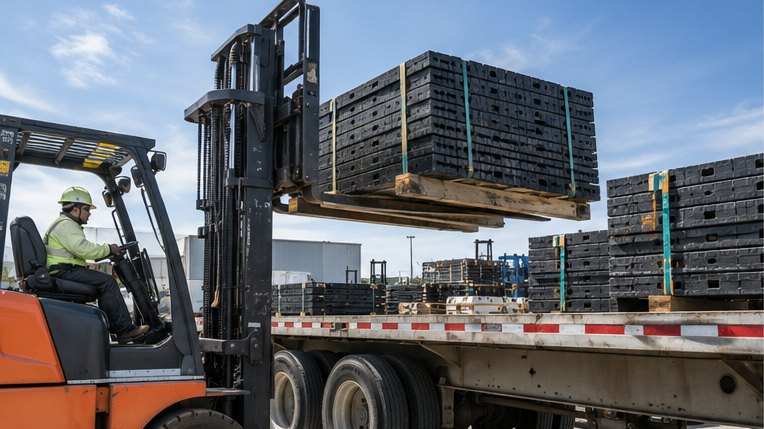
Figure: Interim road demolition, cleaning, recycling and site delivery phases for energy projects, with a focus on “how to track the number of repeat use of paved panels”
The construction organization is as important as the product specifications. Operators should use means of moving a single load, with the vehicle being directed by a commander, without brakes, in situ wheeling or constant pressure. Reducing recovery costs relies on pre-entry baselines, life-cycle controls and reverse evacuation sites, rather than decoupling and concentrating on all issues. Changes in traffic routes, repositioning of equipment or heavy rainfall are followed by a re-examination of the continued applicability of the original programme. A test-pail record of “how many repeats are tracked” should indicate starting and ending locations, vehicle status and release conclusions to facilitate review as construction conditions change.
Car tracks, topsoil erosion, compaction, vegetation, sludge, cracks, permanent deformation, connections and storage should be checked before class, after peak traffic and after rainfall. Each record shall contain the date, location, vehicle, weather, unusual photographs and processing results. In the case of repeated fallout sequence errors in the same area, resulting in higher secondary crushing and restoration costs, the site should be re-analysed, drainage, transport organization and specifications instead of replacing surface components. The inspection form, which revolves around “how the number of repeat use of the pavement is tracked”, is to be accompanied by an error in the order of the separate exit field, resulting in a change in the secondary crushing and recovery costs, and an indication of the repeater and the time of return.
The receiving and inspection information shall be maintained in the form of maps, product numbers, photographs of entry and exit sites, initial ground conditions, abnormal worksheets and demolition records. In the event of a ground or equipment dispute, the information can distinguish between the original soft spot, the use of a change and the removal site damage, and can also quantify the impact on the cost of the project of the secondary crushing and recovery costs caused by the error in the order of the evacuation site. It should also answer whether the “Tracing of the Number of Repeated Use of Pileboards” avoids a subjective description of the closing of the item by removing it in reverse and retaining the emergency route in the order in which the equipment exits.
Progress pressure cannot reduce the security floor. In the event of secondary crushing and restoration costs being increased as a result of a chronology error in the evacuation site, the decision should be made to repair, reroute or replace the product after isolation and identification of the cause. Any measures should avoid introducing new risks of slide, overloading, tripping, electric area intrusion or human-car conflict.
Need for further evaluation of the actual project?
Applications, sizes, quantities, site photographs or drawings and delivery destinations are sent, on which we can identify more suitable products and processing programmes.







