
The answer to the temporary stacking of cables and equipment boxes is to take care of fixed numbers that are not removed from the site. The theme of wind, electricity, photovoltaic and other energy project camps, far from hard roads, focuses on “what to notice about the temporary stacking of cables and equipment boxes”, which is influenced by weather, terrain, vehicles and organizational patterns, with the result that repeated vehicle traffic creates deep fault lines and destroys the grass roots. The project should mark the soft spots, slopes, drainage, underground facilities and vehicle tracks on a single map to bring technology, construction, HSE and procurement data into line.
Inputs can be organized by equipment, ground, route and time, with emphasis on transport distance, terrain, snow and snow season, maximum vehicle, camp layout, handling equipment, stock rotation, supply cycle and destination port. In response to repeated vehicular traffic, which has resulted in deep and ground damage, it is recommended that continuous coverage be planned for the most disadvantaged vehicles, complete wheels and weather changes. In the case of leg pads, the maximum repulsive force of the leg provided by the plant must be obtained, and in the case of passage roads, the total weight of the vehicle, the axle, the tyre and the complete turn track should be used. For “what should be taken into account in the temporary stacking of cables and equipment tanks”, the information review should also draw out the protection and restoration of the boundary of topsoil, cropping layer or grassland and include missing information as an item pending confirmation of the offer and the construction programme.
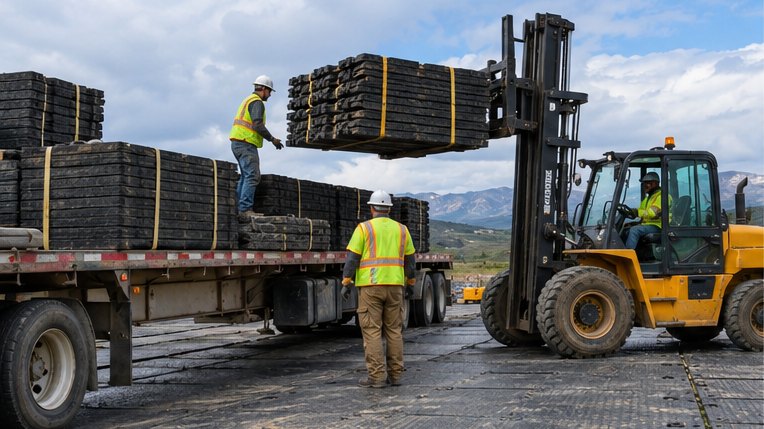
Figure: Camps for wind, photovoltaic and other energy projects, far from hard roads, with a focus on “What to notice about the temporary stacking of cables and equipment boxes”
The site installation should be located with an approved drawing number, and the level, seam, edge and drainage should be inspected at each stage of completion. Remote projects need to use roads, parking, stacks and emergency routes as a logistics system, and single-form product weights are as important as recovery efficiency. The test operation can first be carried out using a low-risk vehicle with a slow-speed straight-line and then gradually verify the turnover, parking and full-loading; it should be discontinued as soon as it is discovered that it continues to sink under the plate, pump mud or branch position. A test-painting record of “what to notice about the temporary stacking of cables and equipment boxes” should indicate the starting and ending position, vehicle condition and release conclusion to facilitate review as construction conditions change.
The maintenance plan should include responsibility for key sections and feeder points, frequency checks, decommissioning thresholds and spare parts locations. Repeated coverage around the most disadvantaged vehicles, complete wheels and weather change planning allows for the timely detection of repeated vehicle traffic and the creation of deep and ground-level damage. Backup panels, connectors and handling tools are also synchronized to avoid mismatches in specifications on site. In the context of “what to look for in the temporary stacking of cables and equipment boxes”, the inspection forms require that the repeated traffic of separate vehicles create deep lines and disrupt changes at the grass-roots level, as well as a reference to the inspector and the time of return.
Construction, logistics, HSE, equipment, site and procurement could be jointly evaluated before the planned expansion. The parties confirm the conditions of movement, suspension, inspection, restoration and delivery to verify whether the continuous coverage according to the most disadvantaged vehicle, complete wheel and weather change planning is truly enforceable. The results of the review should be included in the programme rather than in oral communication. It should also answer whether “the attention to be paid to the temporary stacking of cables and equipment boxes” has been demonstrated to be improved by successive coverage according to the most adverse vehicle, complete wheel and weather change planning, so as to avoid a subjective description of the closing item.
Road-painting and foot mats can only function in the approved construction system and cannot be a substitute for unsatisfactory foundations, damaged equipment or irregularities. Any unknown underground facility, unstable edges, legwork beyond the equipment manual or failure to isolate persons should be suspended and upgraded.
Need for further evaluation of the actual project?
Applications, sizes, quantities, site photographs or drawings and delivery destinations are sent, on which we can identify more suitable products and processing programmes.







