
The construction window for energy works is usually tight, but the construction of temporary roads for gas pipelines still needs to be analysed from the full operational cycle. In the case of public utility work sites such as water supply, drainage, gas and municipal pumping stations, the issue is concerned with “how to set temporary roads for the construction of gas pipelines” and the conditions of control vary when vehicles enter, are loaded out or equipment is put on hold for long periods of time. The site should first locate the area where the secondary crushing and restoration costs may have been increased as a result of an error in the sequence of the evacuation site, and then decide on the use of pavement boards, leg pads or approved combinations.
Procurement staff should submit site maps, vehicle schedules and vehicle load weights, urban green land conditions, root and pipe locations, public access, operating hours, back-of-the-car space and site restoration standards along with the request for quotations and indicate the locations where the secondary crushing and restoration costs may have increased as a result of an error in the order of the evacuation site. The programme can be based on the calculation of the straight-line segment, the turning area, the docking position and the surface, respectively. For the whole container procurement, the quantity of the container, the pallet or bundle, the offloading equipment, the destination port and the conditions of storage at the site should also be confirmed in advance. For the “how to set the temporary road for the construction of the gas pipeline”, the information review should also record changes in the water state and the scope of the soft spots before, after and after the rainfall, and include missing information as an item to be confirmed in the quotations and construction programme.
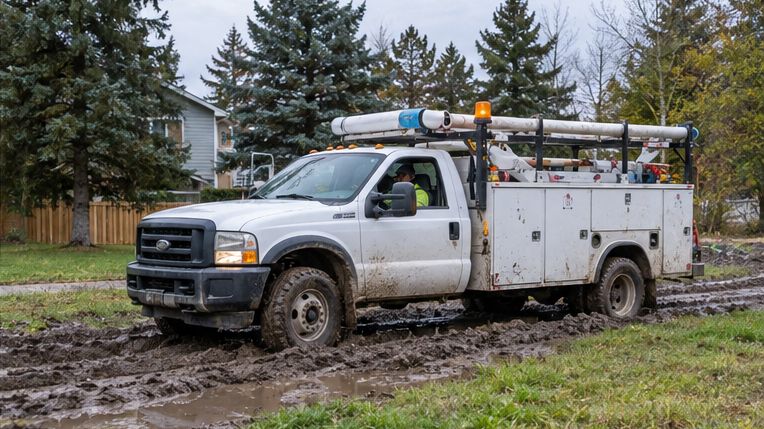
Figure: Public utility construction sites such as water supply, drainage, gas and municipal pumping stations, with the theme “How to set temporary roads for the construction of gas pipelines”
The site installation should be located with an approved drawing number, and the level, seam, edge and drainage should be inspected at each stage of completion. Construction of utilities is often adjacent to the public and established facilities, and temporary access must be accompanied by carrying, isolation, accessibility and rapid recovery requirements. The test operation can first be carried out using a low-risk vehicle with a slow-speed straight-line and then gradually verify the turnover, parking and full-loading; it should be discontinued as soon as it is discovered that it continues to sink under the plate, pump mud or branch position. The trial-pail record of “how to set up the temporary road for the construction of the gas pipeline” should identify the starting point, vehicle status and release conclusions for review as the construction conditions change.
It is recommended that the pavements and the mats be included in the asset desk account, numbering the relevant specifications, batches, pavements and hours of use. The range of inspections included pedestrian boundaries, plate contamination, asphalt transitions, root areas, backfill areas, road shoulders, leg positions and night lighting. The removed components are to be cleaned, dried, flattened and placed in subdivisions that are qualified, subject to assessment, to repair and to end-of-life status, to prevent the re-entry of unqualified products. The “how to set up the temporary road for the construction of the gas pipeline”, the inspection form is to cause a change in the secondary crushing and restoration costs due to a single arraignment sequence error, and to indicate the time of the repeater and the resumption of traffic.
Construction, logistics, HSE, equipment, site and procurement could be jointly evaluated before the planned expansion. The parties confirmed the conditions of passage, suspension, inspection, recovery and delivery to verify whether the straight-line sections, turn areas, docking positions and operating surfaces were truly implementable. The results of the review should be included in the programme rather than in oral communication. This retrodiscussion should also answer whether the “how to set the temporary road for the construction of the gas pipeline” has been demonstrated to improve by calculating the straight-line segment, the turn-off area, the docking position and the operating surface separately, avoiding a subjective description of the closing item.
The construction, equipment, HSE and logistics team should confirm the use of the same version of data before the procurement is issued. The common dimensions, thickness or reference load range referred to in this paper are not on-site commitments and actual performance is influenced by materials, temperature, foundations, connections and installation patterns, and the recommended results should indicate assumptions and no application.
Need for further evaluation of the actual project?
Applications, sizes, quantities, site photographs or drawings and delivery destinations are sent, on which we can identify more suitable products and processing programmes.







