
The answer to this question is whether small-size pavements can be used in narrow neighbourhoods without the fixed number of the site. In the case of public utility work sites such as water supply, drainage, gas and municipal pumping stations, the issue is concerned that “the ability of narrow neighbourhoods to use small-size pavements” is affected by weather, terrain, vehicle and organizational patterns, and that the secondary crushing and restoration costs are increased by the incorrect sequence of the evacuations is only a visible result. The project should mark the soft spots, slopes, drainage, underground facilities and vehicle tracks on a single map to bring technology, construction, HSE and procurement data into line.
A one-time collection of vehicle load weights, urban green land conditions, root and piping positions, public traffic, operational hours, back-to-back space and site restoration standards was recommended prior to the design and request. This topic can begin to form a formula “calculating the line segments, turn areas, docking slots and operating surfaces, respectively”. The standard 15, 20, 25 and 30 mm specifications for paving boards can only be used as the starting point for communication, with the actual selection being combined with materials, size, thickness, single weight, texture, connection, grass-roots support and supplier testing conditions. The information review should also identify the direction of the impervious water flow and set up the drain exits that could be inspected, and include missing information as an item to be confirmed for quotations and construction programmes.
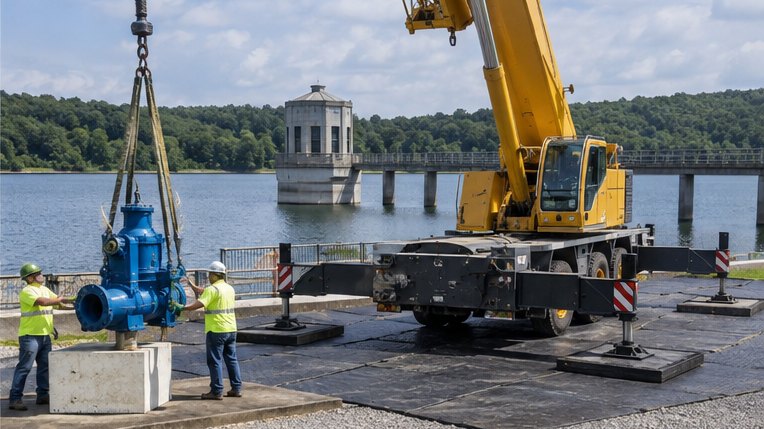
Figure: Public utility construction sites such as water supply, drainage, gas and municipal pumping stations, with a focus on “the possibility of small-sized pavements in narrow neighbourhoods”
A smooth transition should be put in place at the different ground crossings to avoid the sudden impact of vehicles on temporary circuits from hard roads. Once the laying has been completed, the inside and outside of the most heavy vehicles and the brake position will be reviewed on the basis of separate calculations of the line segments, turn areas, docking positions and operating surfaces. Construction of utilities is often adjacent to the public and established facilities, and temporary access must be accompanied by carrying, isolation, accessibility and rapid recovery requirements. Physical segregation and clear rules for release are required in the vicinity of public areas. A test-painted record of “the availability of small-size pavements in narrow blocks” should indicate the starting and ending position, vehicle status and release conclusions to facilitate review as construction conditions change.
The shift is required to report changes in pedestrian boundaries, surface contamination, asphalt transitions, root areas, backfill areas, shoulder, leg positions and night lighting, rather than just describing the appearance. The sutures, shoulders or sub-points repaired in the previous class are reviewed in the next class. In the event that the secondary crushing and restoration costs are increased as traffic increases as a result of an error in the sequence of the evacuation site, the project shall immediately limit, re-route or suspend the equipment until the re-examination passes. The inspection form, which is about “the possibility of using small-size pavements in a narrow neighbourhood”, is intended to result in a change in the secondary crushing and restoration costs due to an error in the order of the separate exit field, and to indicate the time taken by the inspector and his/her return.
The offers from different suppliers should be compared under the same size, material, connection, packaging, delivery and test basis. Supplementation should be requested if the maximum load is given without a description of the ground, distance and load. Energy projects should also focus on batch consistency, port efficiency, repairability and container loading. It should also answer whether “the ability of narrow blocks to use small-size pavements” can be verified for improvement by calculating the line segments, turn areas, docking slots and operating surfaces separately, avoiding a subjective description of the end item.
Progress pressure cannot reduce the security floor. In the event of secondary crushing and restoration costs being increased as a result of a chronology error in the evacuation site, the decision should be made to repair, reroute or replace the product after isolation and identification of the cause. Any measures should avoid introducing new risks of slide, overloading, tripping, electric area intrusion or human-car conflict.
Need for further evaluation of the actual project?
Applications, sizes, quantities, site photographs or drawings and delivery destinations are sent, on which we can identify more suitable products and processing programmes.







