
The goal of sharing the equipment offload area with the transport corridor is to allow construction vehicles to travel within the controlled route, while avoiding turning ground protection into equipment stabilization. With regard to heavy cranes and transport sites around transformers, wind machines and large-scale electrical equipment, the topic is concerned with “the possibility of sharing the equipment discharge area with the transport corridor” and should be checked, inter alia, for errors resulting from different conditions of testing but directly comparing the nominal tonnage. Where there is a gutter, backfilling area, slope or unknown underground facility on the route, the treatment must first be confirmed by the responsible party of the project.
Four school-specific topics are available at sites, equipment, products and operations. The site and equipment column records the maximum retroactivity of the leg, the position of the leg, the base allowed pressure, the distance of the groove from the edge, the suspension radius, the transport axle charge and changes in rainfall, the product column lists the size, thickness, texture, connection and batches, and the operating column specifies the approved road map, numbering and inspection records to manage the site change. Any one still relies on empirical speculation, which could lead to a re-emergence of miscalculation at the peak of the construction, with different test conditions but a direct comparison of the nominal tonnage. For “Sharing of equipment offload areas and transport corridors”, the information review should also identify the direction of the off-board flow and set up the drain exits that can be inspected and include missing information as an item to be confirmed for quotations and construction programmes.
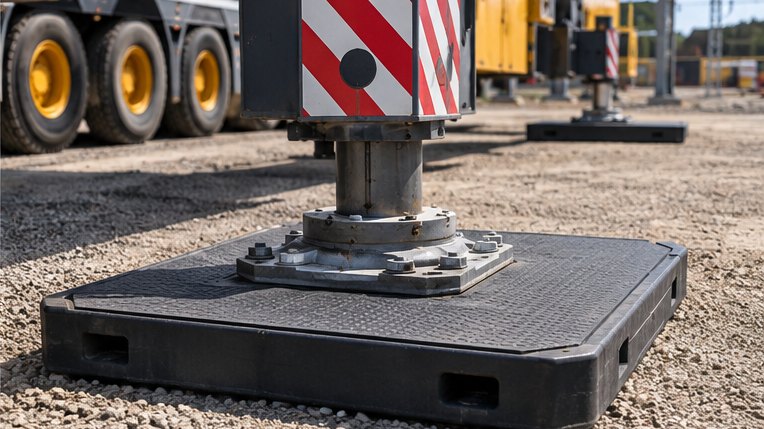
Figure: Heavy cranes and transport sites for transformers, winders and large power plants, with a focus on “Sharing of equipment discharge areas and transport corridors”
The site installation should be located with an approved drawing number, and the level, seam, edge and drainage should be inspected at each stage of completion. The area of the leg pad shall be determined by the maximum retroactivity in conjunction with the confirmed ground-based load, and the pavement shall not automatically replace the accounted hanger operating platform. The test operation can first be carried out using a low-risk vehicle with a slow-speed straight-line and then gradually verify the turnover, parking and full-loading; it should be discontinued as soon as it is discovered that it continues to sink under the plate, pump mud or branch position. “Sharing of the equipment discharge area and the transport corridor” test-painting records should indicate the starting point, vehicle status and release conclusions to facilitate review as construction conditions change.
Special inspections should be added after extreme weather, equipment anomalies or route adjustments. The use of position signs and fixed view photographs for mid-legged, full-exposure, mat deformation, sedimentation, horizontality, edge fractures, road stitches and transport wheels facilitates comparison of deposition and shift. Cleaning the surface of polymers avoids fire, sharp shovels and violent knocks, creating new cracks and stress concentrations. In the context of the “Sharedness of the equipment discharge area with the transport corridor”, the inspection forms are to be presented in separate columns with different test conditions, but directly compared to the nominal tonnage, resulting in a miscalculation change, with an indication of the inspector and the time of return.
A reset is to distinguish between product problems and changes in condition. The original programme may no longer be appropriate if the vehicle is heavy, routed, rainfall increases or cover periods are extended. These changes were recorded with the results of the implementation of the approved road map, numbering and inspection logs to manage on-site changes, and the next time it was known whether the thickness, width, quantity or construction organization should be adjusted. It should also answer whether “the co-location of the equipment discharge area with the transport corridor” has been verified as an improvement through the use of approved road maps, numbering and inspection logs to manage on-site changes and to avoid the closure of items with only subjective descriptions.
Road-painting and foot mats can only function in the approved construction system and cannot be a substitute for unsatisfactory foundations, damaged equipment or irregularities. Any unknown underground facility, unstable edges, legwork beyond the equipment manual or failure to isolate persons should be suspended and upgraded.
Need for further evaluation of the actual project?
Applications, sizes, quantities, site photographs or drawings and delivery destinations are sent, on which we can identify more suitable products and processing programmes.







