
Remote project camp service vehicle roads should be paved from the most unfavourable rather than the average. Wind, photovoltaic and other energy project camps, far from hard roads, are concerned that “how to pave the remote project camp service road” may be affected by heavy vehicle cycle, rainfall and scalding at the same time, and that secondary crushing and recovery costs will increase with traffic as a result of the incorrect sequence of evacuation sites. It would be clearer for on-site execution to first determine the conditions for allowing deposition, decommissioning and those responsible, and then select product specifications.
Inputs can be organized by equipment, ground, route and time, with emphasis on transport distance, terrain, snow and snow season, maximum vehicle, camp layout, handling equipment, stock rotation, supply cycle and destination port. In response to the increase in secondary crushing and restoration costs as a result of the ceremonial error in the setting, it is recommended that the minimum effective area of the leg pads be accounted for on the basis of maximum reversibility and endurance. In the case of leg pads, the maximum repulsive force of the leg provided by the plant must be obtained, and in the case of passage roads, the total weight of the vehicle, the axle, the tyre and the complete turn track should be used. For the “how to pave the road for service vehicles in remote project camps”, the information review should also identify the broadest vehicle profile, internal wheel differentials and side safety residuals, and include missing information as an item to be confirmed in the quotation and construction programme.
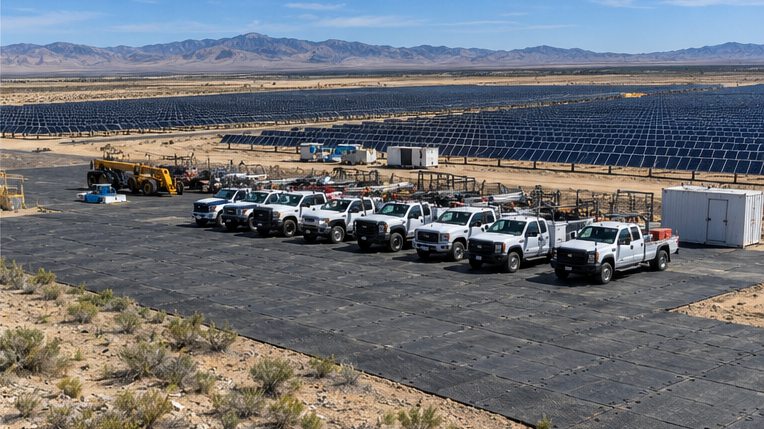
Figure: Camps for wind, photovoltaic and other energy projects, far from hard roads, with a focus on “How to pave a service bus road for remote project camps”
The installation should leave a photo, location and measurement record. First, ground-level levelling, drainage and underground facilities are identified, and the complete contact, connection, edge and transition of the pavement is checked, or the size, location and centering of the leg pads are checked. Remote projects need to use roads, parking, stacks and emergency routes as a logistics system, and single-form product weights are as important as recovery efficiency. Areas not eligible for acceptance should not be replaced by speed-limit signs alone. The trial-pave record of “how to pave the service road for remote project camps” should indicate the starting and ending position, vehicle status and release conclusions to facilitate review as construction conditions change.
The inspection cycle can be shortened at an early stage of use and then stabilized before adjusting to vehicle cycles and weather. The maintenance staff focused on stock levels, route continuity, drainage, shoulders, pollution, plate numbering, handling safety and the clean-up of emergency vehicles, as well as on the driver ' s compliance with speed limits and shift requirements. Any unconfirmed sub-board support, edge instability or foot contact should first be disabled. The “how to pave the service road” around the remote project camp would be subject to a separate ceremonial error, which would result in a change in the secondary crushing and recovery costs, as well as an indication of the inspector and the time of the resumption.
The offers from different suppliers should be compared under the same size, material, connection, packaging, delivery and test basis. Supplementation should be requested if the maximum load is given without a description of the ground, distance and load. Energy projects should also focus on batch consistency, port efficiency, repairability and container loading. It should also answer whether the “how to pave the remote project camp service road” has been certified for improvement by accounting for the minimum effective area of the leg pads on the basis of maximum retroactivity and local durability, avoiding a subjective description of the closure.
Road-painting and foot mats can only function in the approved construction system and cannot be a substitute for unsatisfactory foundations, damaged equipment or irregularities. Any unknown underground facility, unstable edges, legwork beyond the equipment manual or failure to isolate persons should be suspended and upgraded.
Need for further evaluation of the actual project?
Applications, sizes, quantities, site photographs or drawings and delivery destinations are sent, on which we can identify more suitable products and processing programmes.







