
The construction window for energy works is usually tight, but full operational cycle analysis is still required on how to restore the surface after the temporary parking area has been removed. In the case of camps for wind, photovoltaic and other energy projects, far from hard roads, the subject concerns “how to restore the surface after temporary parking areas have been removed”, for example, the conditions of control when vehicles enter, are loaded out or equipment is parked for long periods of time vary. The site should first locate the area where the ground-based load drops after rainfall and a pump mud or error table is likely to occur, and then decide on the use of pavements, leg pads or approved combinations.
Procurement staff should submit site maps, vehicle schedules and transport distances, terrain, snow and snow seasons, maximum vehicles, camp layout, handling equipment, stock rotation, supply cycles and destination ports along with the request for quotations, and indicate where the base load has declined following rainfall and where pumping mud or error platforms may occur. The programme allows for zonal configurations based on the certification of panels, floors and vehicle operating space through representative trial workshops. For the whole container procurement, the quantity of the container, the pallet or bundle, the offloading equipment, the destination port and the conditions of storage at the site should also be confirmed in advance. For the “how to restore the surface after the temporary parking area has been removed”, the information review should also be carried out in the reverse order of removal and loading of the last piece of equipment and include missing information as an item to be confirmed for the quotation and construction programme.
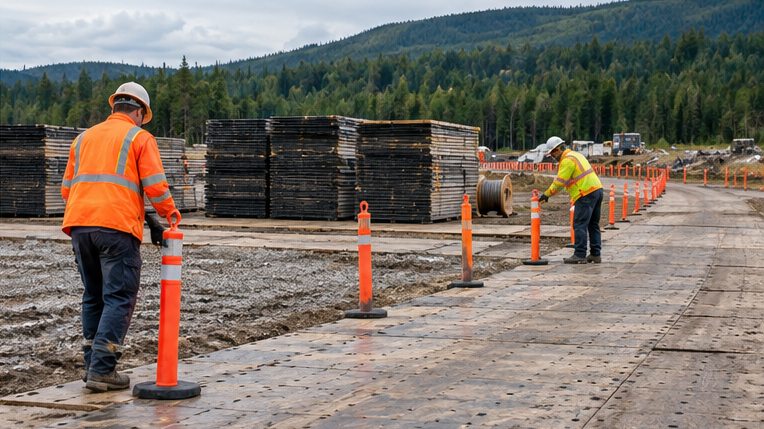
Figure: Camps for wind, photovoltaic and other energy projects, far from hard roads, with a focus on “How to restore the surface after the removal of temporary parking areas”
Pre-implementation should be preceded by the containment of routes, the removal of sharp stones, stakes and miscellaneous items that may form a spot load, the repair of deep-pit tracks and the removal of horizontal drainage. Remote projects need to use roads, parking, stacks and emergency routes as a logistics system, and single-form product weights are as important as recovery efficiency. The plates should be prepared continuously at the stabilization end, with the bends, reverses and parking areas being expanded as appropriate; the leg mats should be flat, intermediated and in full contact, and it should not be allowed to be filled with random stacking. Test-painted records of “how to restore the surface after the temporary parking area has been removed” should indicate the starting and ending location, vehicle status and release conclusions, to facilitate review as construction conditions change.
Special inspections should be added after extreme weather, equipment anomalies or route adjustments. The number of stockpiles, route continuity, drainage, shoulders, pollution, plate numbering, net empty location tags for handling safety and emergency vehicles and fixed view photographs allow for comparison of deposition and migration. Cleaning the surface of polymers avoids fire, sharp shovels and violent knocks, creating new cracks and stress concentrations. Around “how to restore the surface after the temporary parking area has been removed”, the patrol forms are to show a separate drop in the base load after rainfall and changes in pump mud or wrong table, with an indication of the inspector and the time of return.
Construction, logistics, HSE, equipment, site and procurement could be jointly evaluated before the planned expansion. The parties identified conditions for passage, suspension, inspection, restoration and delivery, respectively, to verify whether the sutures, ground floors and vehicle operating space were truly enforceable through representative trial workshops. The results of the review should be included in the programme rather than in oral communication. It should also answer whether the “how to restore the surface after the temporary parking area has been removed” has been certified for improvement through the certification of panels, floors and vehicle operating space through representative trial workshops, avoiding the closure of the item by subjective descriptions only.
The construction, equipment, HSE and logistics team should confirm the use of the same version of data before the procurement is issued. The common dimensions, thickness or reference load range referred to in this paper are not on-site commitments and actual performance is influenced by materials, temperature, foundations, connections and installation patterns, and the recommended results should indicate assumptions and no application.
Need for further evaluation of the actual project?
Applications, sizes, quantities, site photographs or drawings and delivery destinations are sent, on which we can identify more suitable products and processing programmes.







