
In the interim road demolition, cleaning, recycling and site delivery phase of the energy project, the focus of the topic is on “How the energy project records the state of the ground before entering the field”, which does not appear to mean that there is a continuous burden under the plate. In response to the energy project's recording of the state of the ground before entering the field, the ground condition, weather and the most heavy vehicle condition should be recorded before entering the site, as temporary changes in the construction route may result in vehicles entering unprotected areas after repeated traffic. The establishment of baseline photographs and measurement points will facilitate follow-up inspections and recovery of acceptances.
A one-time collection of pre-entry photographs, area of coverage, time of use, weather, vehicle cycle, demolition sequence, cleaning conditions, damage rate and acceptance criteria is recommended before design and request for quotations. This topic can begin to form a formula “calculating the line segments, turn areas, docking slots and operating surfaces, respectively”. The standard 15, 20, 25 and 30 mm specifications for paving boards can only be used as the starting point for communication, with the actual selection being combined with materials, size, thickness, single weight, texture, connection, grass-roots support and supplier testing conditions. For “How the energy project records the state of the ground prior to entry”, the information review should also calculate the area covered by the line, the bend, the meeting and the reverse area, respectively, and include missing information as an item to be confirmed in the quotation and construction programme.
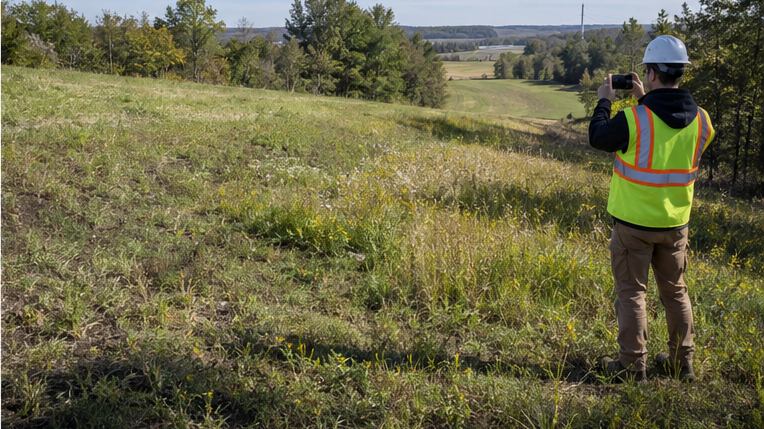
Figure: Interim road demolition, cleaning, recycling and site delivery phases for energy projects, with a focus on “How energy projects record the state of the ground before entry”
Pre-implementation should be preceded by the containment of routes, the removal of sharp stones, stakes and miscellaneous items that may form a spot load, the repair of deep-pit tracks and the removal of horizontal drainage. Reducing recovery costs relies on pre-entry baselines, life-cycle controls and reverse evacuation sites, rather than decoupling and concentrating on all issues. The plates should be prepared continuously at the stabilization end, with the bends, reverses and parking areas being expanded as appropriate; the leg mats should be flat, intermediated and in full contact, and it should not be allowed to be filled with random stacking. The test-pail record of “how the energy project records the state of the ground before entering the field” should indicate the starting and ending position, vehicle status and release conclusions to facilitate review as construction conditions change.
The inspection should not simply be “normal” and should be identified on a case-by-case basis around the tracks, topsoil erosion, pressure, vegetation, sludge, cracks, permanent deformations, links and stocking, and should be divided into three levels of observation, restriction and decommissioning. For each of the key points to be calculated for the straight-line segment, turn-off area, docking position and surface, a fixed photo angle and a measurement benchmark should be set. A loose connection, a permanent deformation, a breach through or a deviation of a branch shall be immediately isolated. The inspection form, which revolves around “how the energy project records the state of the ground before entering the site”, lists the temporary changes in the construction route that allow the vehicle to enter the unprotected area, with an indication of the repeater and the time of return.
The full life-cycle costs include procurement or leasing, shipping, unloading, laying, inspection, cleaning, maintenance, warehousing and ground restoration. The project should compare the implementation costs calculated separately for the straight-line segment, the turn-off area, the docking position and the operational surface with the costs of stoppage or repair resulting from the temporary change in the construction route that resulted in vehicles entering unprotected areas, and should not be determined solely on the basis of single-block product prices. It should also answer whether “how the energy project records the state of the ground before entering the field” has been proven to be improved by calculating the straight-line segment, the bend area, the docking position and the operating surface separately, avoiding a subjective description of the closing item.
This topic can be summarized as first confirming the boundary of the work, then configure the appropriate product, and then validate it with test run, inspection and project data. The formal programme should identify those responsible, the restrictions, the criteria for decommissioning, the means of recovery and the emergency route, so as to avoid the loss of critical information following changes in the class or contractor.
Need for further evaluation of the actual project?
Applications, sizes, quantities, site photographs or drawings and delivery destinations are sent, on which we can identify more suitable products and processing programmes.







