
The purpose of the pavement and legmatization of a whole container is to allow construction vehicles to move within the controlled route, while avoiding turning ground protection issues into equipment stabilization problems. In the context of the process of procurement of pavements and leg mats by energy contractors, leasers and distributors, the subject is concerned with “the ability of pavements and leg pads to combine a whole container”, and in particular, the temporary change in the construction route should be checked to bring vehicles into the unprotected area. Where there is a gutter, backfilling area, slope or unknown underground facility on the route, the treatment must first be confirmed by the responsible party of the project.
A one-time collection of vehicle and equipment data, ground conditions, route size, quantity, life cycle, product specifications, test basis, packaging, trade terms and destination port is recommended before design and request for quotations. The topic could begin with a programme of “continuing coverage according to the most adverse vehicle, complete wheel and weather change planning”. The standard 15, 20, 25 and 30 mm specifications for paving boards can only be used as the starting point for communication, with the actual selection being combined with materials, size, thickness, single weight, texture, connection, grass-roots support and supplier testing conditions. For “the ability of pavement boards and leg pads to mix a whole cabinet”, the information review should also place fixed observation points on the outside side of the shoulder, slope and turn, and include missing information as an item to be confirmed in the quotation and construction programme.
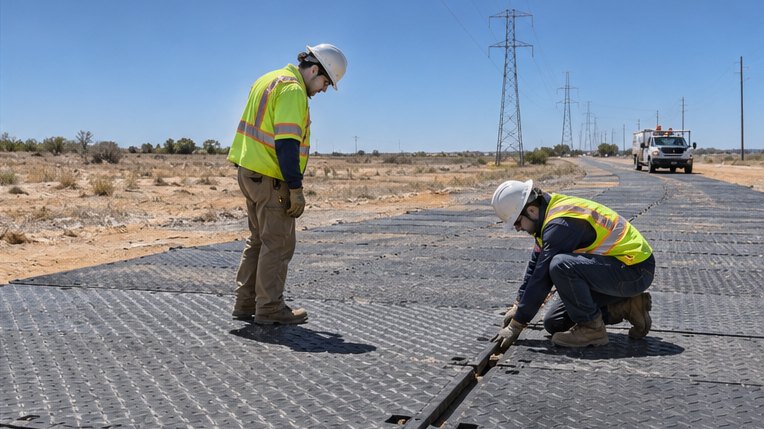
Figure: Processes for the procurement of pavements and mats by energy contractors, leasers and distributors, with a focus on the “compatibility of pavements and mats”
A smooth transition should be put in place at the different ground crossings to avoid the sudden impact of vehicles on temporary circuits from hard roads. The internal and external wheels and brake locations of the most heavy vehicles will be reviewed after successive coverage has been completed in accordance with the most unfavourable vehicle, complete wheel and weather change planning. The procurement comparison must use the same size, material, test conditions and delivery boundary, and the reference values of 50 to 200 tons cannot be understood in isolation from the support conditions. Physical segregation and clear rules for release are required in the vicinity of public areas. The test-pail record of the “compatibility of the pavement and the mats” should indicate the starting and ending position, vehicle condition and release conclusions to facilitate review as construction conditions change.
The inspection cycle can be shortened at an early stage of use and then stabilized before adjusting to vehicle cycles and weather. The maintenance staff focused on the size difference, thickness, weight, texture, connection holes, appearance, packaging, container manifest, batch information and arrival and inspection, as well as on the driver ' s compliance with speed limits and shift requirements. Any unconfirmed sub-board support, edge instability or foot contact should first be disabled. The inspection form, which revolves around “the ability of pavement boards and leg pads to combine an entire container”, contains a separate list of temporary changes in the construction route that would allow the vehicle to enter the unprotected area and indicate the repeater and the time of return.
The offers from different suppliers should be compared under the same size, material, connection, packaging, delivery and test basis. Supplementation should be requested if the maximum load is given without a description of the ground, distance and load. Energy projects should also focus on batch consistency, port efficiency, repairability and container loading. It should also answer whether “the ability of pavement boards and leg cushions to combine a whole cabinet” has been improved by a continuous coverage according to the most unfavourable vehicle, complete wheel and weather change, and avoid a subjective description of the final item.
This topic can be summarized as first confirming the boundary of the work, then configure the appropriate product, and then validate it with test run, inspection and project data. The formal programme should identify those responsible, the restrictions, the criteria for decommissioning, the means of recovery and the emergency route, so as to avoid the loss of critical information following changes in the class or contractor.
Need for further evaluation of the actual project?
Applications, sizes, quantities, site photographs or drawings and delivery destinations are sent, on which we can identify more suitable products and processing programmes.







