
The way in which the utility works at night to manage temporary access should start from the most unfavourable rather than the average. Public utility construction sites such as water supply, drainage, gas and municipal pumping stations are concerned that “how public utility night repairs manage temporary access” may be affected by heavy vehicle cycle, rainfall and run-time compression at the same time, while miscalculation resulting from different test conditions compared directly to the nominal tonnage may increase traffic. It would be clearer for on-site execution to first determine the conditions for allowing deposition, decommissioning and those responsible, and then select product specifications.
The product configuration cannot be determined by area or thickness alone. The project should verify vehicle load weights, urban green land conditions, root and line locations, public access, operational time, back-of-the-car space and site restoration standards, and make a direct comparison of test conditions with the nominal tonnage resulting in miscalculation into drainage, carrying, stabilization, surface pull and restoration requirements. When setting speed limits, prohibiting in-situ wheeling and making special arrangements for commanding the ICP for heavy vehicles, consideration will also be given to handling tools, manual weights, spare quantities, cleaning and backfilling. The information review should also limit long-term static, in situ wheeling and unplanned queuing of vehicles and include missing information as items for confirmation of quotations and construction programmes.
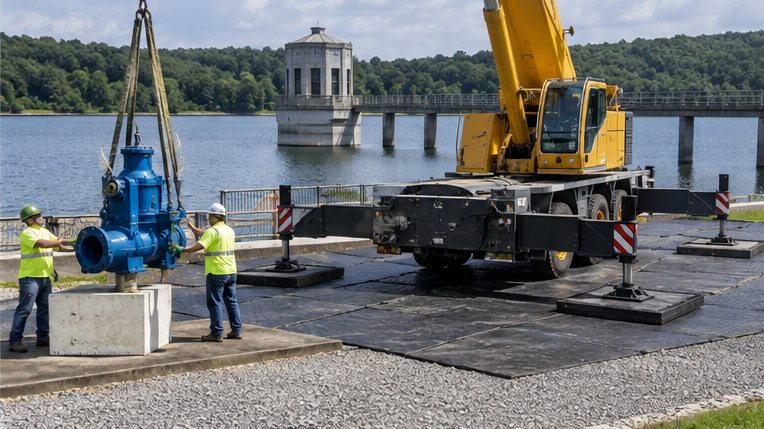
Figure: Public utility construction sites such as water supply, drainage, gas and municipal pumping stations, with a focus on “How to manage temporary access for utility night inspections”
The drainage direction, soft spots and support under the plate should be compared before and after the rainfall, and the water should not be enclosed under the plate. Construction of utilities is often adjacent to the public and established facilities, and temporary access must be accompanied by carrying, isolation, accessibility and rapid recovery requirements. If the test conditions are different but the miscalculation caused by the nominal tonnage is already present, the area should first be sealed, the lifting plate should be connected to the drain and then the repositioning; the reason cannot normally be eliminated by simply cleaning the surface or adding a sheet. A test-pail record of “how the utility works at night to manage the temporary passage” should indicate the starting and ending position, vehicle condition and release conclusions to facilitate review as construction conditions change.
Inspections should not only be “normal” and should be identified on a case-by-case basis around pedestrian boundaries, plate contamination, asphalt transitions, root areas, backfill areas, shoulders, legs positions and night lighting, and be divided into three levels of observation, restriction and decommissioning. A fixed photo angle and measurement benchmark should be established for key points that are designed to set speed limits, prohibit in situ wheeling and place a person in command for heavy vehicles. A loose connection, a permanent deformation, a breach through or a deviation of a branch shall be immediately isolated. In the context of “how temporary passages are managed by night inspections of utilities”, the inspection forms need to be presented in a separate series of test conditions, but directly compared with the changes in miscalculation caused by the nominal tonnage, with an indication of the inspector's time of return.
The impact assessment cannot be based solely on the movement of vehicles on the same day. The project compares vehicle waiting, trapping, maintenance hours, cleaning time, loss of connection, site restoration area and evacuation cycle, and records weather and traffic simultaneously. The question of whether this option is suitable for replication at the next energy project is determined by the creation of data based on different test conditions but directly comparing the data with miscalculated tonnage. It should also answer whether the “how to manage temporary passages by night inspections of public utilities” has been certified as improved by setting speed limits, prohibiting in-situ wheeling and arranging exclusive command for heavy vehicles, so as to avoid the closure of the item by a subjective description only.
This topic can be summarized as first confirming the boundary of the work, then configure the appropriate product, and then validate it with test run, inspection and project data. The formal programme should identify those responsible, the restrictions, the criteria for decommissioning, the means of recovery and the emergency route, so as to avoid the loss of critical information following changes in the class or contractor.
Need for further evaluation of the actual project?
Applications, sizes, quantities, site photographs or drawings and delivery destinations are sent, on which we can identify more suitable products and processing programmes.







