
The goal of reducing the level of recovery by the use of paved panels for new energy projects is to allow construction vehicles to move within controlled routes, while avoiding turning ground protection issues into equipment stabilization problems. In the context of the interim road demolition, cleaning, recycling and site delivery phase of the energy project, the topic is concerned with “the extent to which new energy projects can reduce recovery by using pavements” and should, inter alia, check the secondary crushing and restoration costs resulting from the incorrect sequence of the divers. Where there is a gutter, backfilling area, slope or unknown underground facility on the route, the treatment must first be confirmed by the responsible party of the project.
The focus of the topic is not on the choice of the thickest or the most heavy products, but on the establishment of a match. Based on pre-entry photographs, area of coverage, time of use, weather, vehicle cycle, demolition sequence, cleaning conditions, damage rate and acceptance standard identification control conditions, the final coverage, connection and back-up quantity is then removed in reverse and the emergency route is maintained in the order of exit of the equipment. In the case of products requiring cross-project turnaround, the numbering, loss rate, cleaning time and volume of transport should also be included in the total cost. For “the extent to which new energy projects can reduce recovery by using paved panels”, the information review should also check the main route starting endpoints, the softest sections and the location of emergency rerouting, and include missing information as an item to be confirmed in the quotation and construction programme.
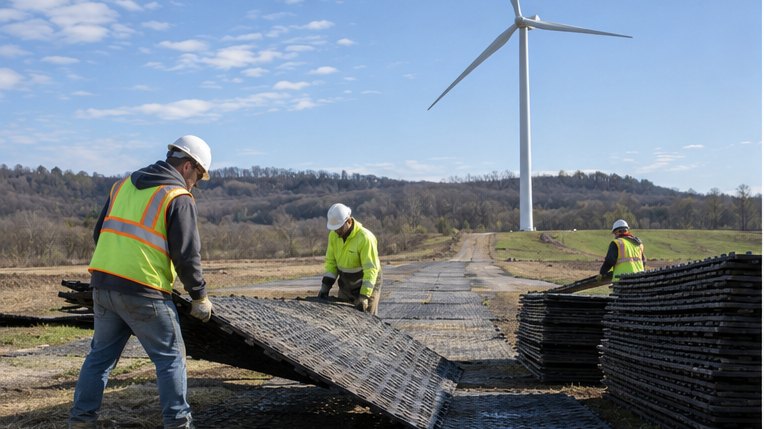
Figure: Interim road demolition, cleaning, recycling and site delivery phases for energy projects, with a focus on “How much recovery can be reduced by the use of pavements for new energy projects”
Pre-implementation should be preceded by the containment of routes, the removal of sharp stones, stakes and miscellaneous items that may form a spot load, the repair of deep-pit tracks and the removal of horizontal drainage. Reducing recovery costs relies on pre-entry baselines, life-cycle controls and reverse evacuation sites, rather than decoupling and concentrating on all issues. The plates should be prepared continuously at the stabilization end, with the bends, reverses and parking areas being expanded as appropriate; the leg mats should be flat, intermediated and in full contact, and it should not be allowed to be filled with random stacking. The test-pail record of “the extent to which the new energy project can be reduced by the use of paved panels” should indicate the starting point, vehicle status and release conclusions to facilitate review as construction conditions change.
The maintenance plan should include responsibility for key sections and feeder points, frequency checks, decommissioning thresholds and spare parts locations. The reversal of the emergency route around the exit sequence of the equipment and the retention of the emergency route until the final execution of the re-examination will prompt the detection of secondary crushing and recovery costs due to the error of the evacuation site sequence. Backup panels, connectors and handling tools are also synchronized to avoid mismatches in specifications on site. In the context of “how much recovery can be reduced by the use of pavement panels for new energy projects”, the inspection forms are to cause a change in the secondary crushing and recovery costs due to an error in the order of the separate field and to indicate the inspector's return time.
The offers from different suppliers should be compared under the same size, material, connection, packaging, delivery and test basis. Supplementation should be requested if the maximum load is given without a description of the ground, distance and load. Energy projects should also focus on batch consistency, port efficiency, repairability and container loading. It should also answer whether “how much recovery can be reduced by the use of pavements for new energy projects” is improved by the reverse removal and retention of the emergency route in the order in which the equipment was withdrawn, and at the end of the day, by avoiding a subjective description.
The ultimate goal is for the interim road demolition, cleaning, recycling and site delivery phases of the energy project to focus on “how much road pavement can be used for new energy projects to reduce recovery” and to continue to operate with clear limits and acceptable risks and to successfully restore the ground after the completion of the project. By connecting the design, product, operation, inspection and evacuation sites, the secondary crushing and restoration costs will not be repeated during the rush phase as a result of a chronology error.
Need for further evaluation of the actual project?
Applications, sizes, quantities, site photographs or drawings and delivery destinations are sent, on which we can identify more suitable products and processing programmes.







