
When discussing whether the temporary parking area was only paved or fully covered, the project manager could not ask only how many tons the pavement could bear. Wind, voltage and other energy project camps, far from hard roads, are concerned about the different effects of tyre landings, axleloads, turnovers, brakes and static bearings in “Temporary parking areas are paved or fully covered”, while temporary changes in construction routes often result in vehicles entering unprotected areas in the most unfavourable positions. Reasonable coverage can be determined only if the routes, terminals and emergency exits must be secured.
The product configuration cannot be determined by area or thickness alone. The project should verify transport distance, terrain, snow and snow season, maximum vehicles, camp layout, handling equipment, stock rotation, supply cycle and destination port, and then convert temporary changes in construction routes into drainage, carrying, stabilization, surface pull and restoration requirements for vehicles entering unprotected areas. Moving tools, manual weights, back-up quantities, cleaning and back-to-back stacking should also be considered in the context of the reverse removal and retention of emergency routes in the order of exit of equipment until the final ICP. For “the temporary parking area is only paved or fully covered”, the information review should also check the continuity of the lighting, reflective boundary and night shift records and include missing information as items to be confirmed for quotations and construction programmes.
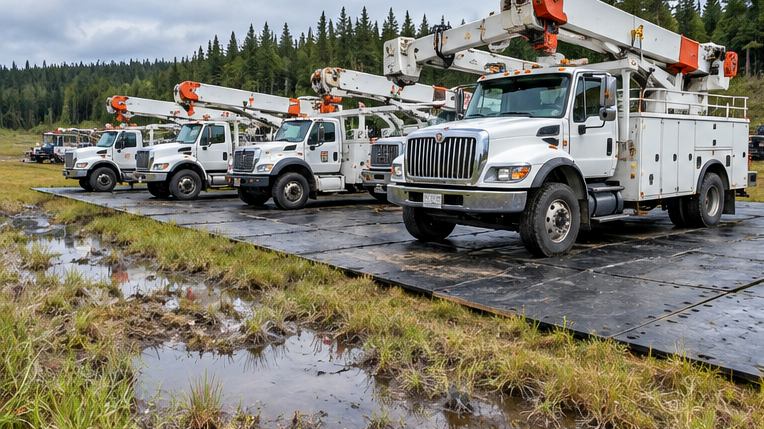
Figure: Camps for wind, photovoltaic and other energy projects, far from hard roads, with a focus on “Was the temporary parking area paved or fully covered”
A representative route or a feeder may be selected for a controlled trial pavement to cover the softest floor and the most heavy equipment condition. Remote projects need to use roads, parking, stacks and emergency routes as a logistics system, and single-form product weights are as important as recovery efficiency. The decision to increase width, improve drainage or reorient traffic is then taken by means of experimental observation of grass-roots, sewn, tyre tracks and operating space. The test-painting record of the temporary parking area should indicate the starting and ending position, vehicle status and release conclusion to facilitate review as construction conditions change.
The maintenance plan should include responsibility for key sections and feeder points, frequency checks, decommissioning thresholds and spare parts locations. With regard to the reverse dismantling of the emergency route in the sequence of equipment withdrawals and the retention of the emergency route until the final implementation of the re-examination, it was found in a timely manner that temporary changes in the construction route resulted in vehicles entering the unprotected area. Backup panels, connectors and handling tools are also synchronized to avoid mismatches in specifications on site. Around the “temporary parking area is only paved or fully covered”, the patrol forms need to list, on a separate basis, temporary changes in the construction route, changes in the vehicle's access to the unprotected area and to indicate the repeater and the time of return.
The offers from different suppliers should be compared under the same size, material, connection, packaging, delivery and test basis. Supplementation should be requested if the maximum load is given without a description of the ground, distance and load. Energy projects should also focus on batch consistency, port efficiency, repairability and container loading. It should also answer whether “the temporary parking area will only be paved or fully covered” will be improved by the reverse removal and retention of the emergency route in the order in which the equipment was withdrawn, and at the end of the day, by avoiding a subjective description only.
The construction, equipment, HSE and logistics team should confirm the use of the same version of data before the procurement is issued. The common dimensions, thickness or reference load range referred to in this paper are not on-site commitments and actual performance is influenced by materials, temperature, foundations, connections and installation patterns, and the recommended results should indicate assumptions and no application.
Need for further evaluation of the actual project?
Applications, sizes, quantities, site photographs or drawings and delivery destinations are sent, on which we can identify more suitable products and processing programmes.







