
In the case of heavy lifting and transport sites for transformers, wind and large-scale electrical equipment, the issue is concerned with “how to convert the maximum retroactivity of the leg to the area of the leg cushion”, which does not appear to mean that there is a continuous burden under the plate. The ground condition, weather and the most heavy vehicle condition should be recorded before entering the field for the conversion of the maximum retroactivity of the leg, as the secondary crushing and restoration cost increases may occur after repeated traffic due to an error in the sequence of the evacuation site. The establishment of baseline photographs and measurement points will facilitate follow-up inspections and recovery of acceptances.
If the project needs to be accompanied by a pavement and a mat, an optional table should be established. The former are dominated by continuous support on the route, axle and the grass-roots level, while the latter are dominated by maximum reversibility of the legs and allowing for ground bearing. In combination with the plant ' s maximum retrogressive leg, leg position, ground-based allowance for pressure, gutter distance to edge, suspension radius, transport axle charge and rainfall change, continuous coverage according to the most unfavourable vehicle, complete wheel and weather variability can be avoided as mutually viable components. For “how to convert the maximum retroactivity of the leg to the area of the leg cushions”, the information review should also mark the change in slopes, equipment creeping capacity and the brake area of the slope on the map and include missing information as a pending item for the quotation and construction programme.
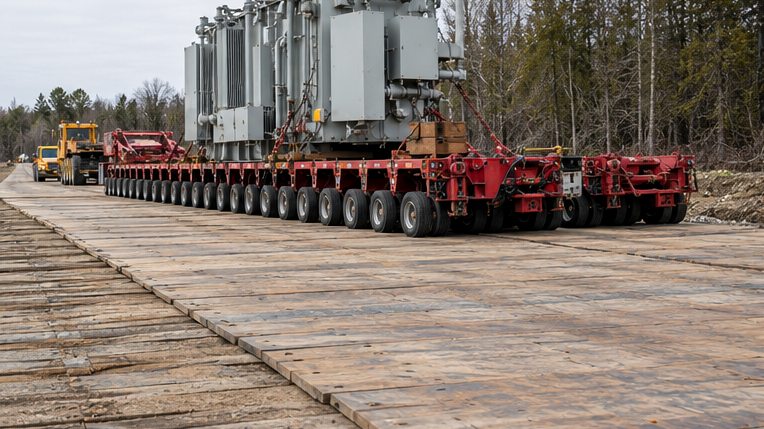
Figure: Heavy cranes and transport sites for transformers, wind and large-scale electrical equipment, with a focus on “how to convert the maximum retroactivity of the leg to the area of the leg cushion”
In the absence of space on the ground, work cannot be undertaken by reducing the necessary cover or moving legs to the shoulder of the road. Vehicle stationing and construction should be reordered to provide sufficient space for “continuing coverage according to the most unfavourable vehicle, complete wheel and weather change”. The area of the leg pad shall be determined by the maximum retroactivity in conjunction with the confirmed ground-based load, and the pavement shall not automatically replace the accounted hanger operating platform. Any forced overlays of holes, temporary mats or uncounted should be returned to the technical manager for evaluation. The test-past record of “how the maximum retroactivity of the leg is translated into the area of the leg cushion” should indicate the starting and ending position, the vehicle's condition and the release conclusion, to facilitate review as the construction conditions change.
Inspections cannot be written only as “normal” and should be identified on a case-by-case basis around the middle of the legs, full contact, mat deformation, deposition, horizontality, cleavage on the edges, road stitches and transport wheels, with the anomaly being classified into three levels of observation, restriction and decommissioning. For key points that are planned for continuous coverage by the most disadvantaged vehicles, complete wheels and weather changes, fixed photo angles and measurement benchmarks should be set. A loose connection, a permanent deformation, a breach through or a deviation of a branch shall be immediately isolated. The inspection forms were to be separated by an error in the sequence of the field and to cause a change in the secondary crushing and recovery costs, and to indicate the time of the repeater and the resumption of traffic.
The impact assessment cannot be based solely on the movement of vehicles on the same day. The project compares vehicle waiting, trapping, maintenance hours, cleaning time, loss of connection, site restoration area and evacuation cycle, and records weather and traffic simultaneously. The question of whether the programme is suitable for replication at the next energy project can only be determined when data are created around the secondary crushing and restoration costs caused by an error in the sequence of the fallout field. This retrodiscussion should also answer whether “how the maximum retroactivity of the leg is translated into the area of the leg mattress” has been demonstrated to improve through continuous coverage according to the most adverse vehicle, complete wheel and weather change, avoiding a subjective description of the closing item.
Progress pressure cannot reduce the security floor. In the event of secondary crushing and restoration costs being increased as a result of a chronology error in the evacuation site, the decision should be made to repair, reroute or replace the product after isolation and identification of the cause. Any measures should avoid introducing new risks of slide, overloading, tripping, electric area intrusion or human-car conflict.
Need for further evaluation of the actual project?
Applications, sizes, quantities, site photographs or drawings and delivery destinations are sent, on which we can identify more suitable products and processing programmes.







