
Answering the question on how the supplier plant capacity was reviewed by the energy contractor and did not depart from the fixed number at the site. The process of procurement of pavements and leg pads by energy contractors, leasers and distributors focuses on how “energy contractors audit the capacity of the supplier plant” is influenced by weather, terrain, vehicle and organizational patterns, and the lack of information leading to mismatches between specifications and quantities and field conditions is only a visible result. The project should mark the soft spots, slopes, drainage, underground facilities and vehicle tracks on a single map to bring technology, construction, HSE and procurement data into line.
The focus of the topic is not on the choice of the thickest or the most heavy products, but on the establishment of a match. Coverage, connection and standby quantities are then determined by management of on-site changes using approved road maps, numbering and inspection records, based on vehicle and equipment data, ground conditions, route size, quantity, life cycle, product specifications, test basis, packaging, trade terms and destination port identification controls. In the case of products requiring cross-project turnaround, the numbering, loss rate, cleaning time and volume of transport should also be included in the total cost. For the “how the energy contractor reviews the vendor's plant capacity”, the information review should also calculate the area covered by the line, the bend, the meeting and the reverse areas, respectively, and include the missing information as an item pending confirmation of the offer and the construction programme.
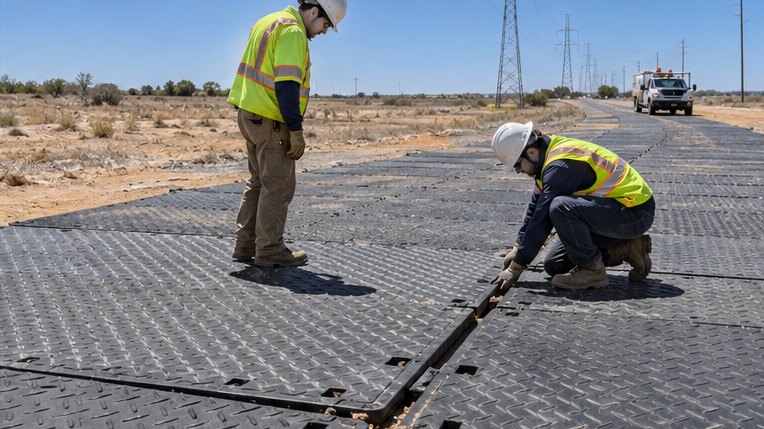
Figure: Processes for the procurement of pavements and leg mats by energy contractors, leasers and distributors, with a focus on “How energy contractors audit supplier plant capacity”
The installation should leave a photo, location and measurement record. First, ground-level levelling, drainage and underground facilities are identified, and the complete contact, connection, edge and transition of the pavement is checked, or the size, location and centering of the leg pads are checked. The procurement comparison must use the same size, material, test conditions and delivery boundary, and the reference values of 50 to 200 tons cannot be understood in isolation from the support conditions. Areas not eligible for acceptance should not be replaced by speed-limit signs alone. The test-pail record of the “energy contractor's review of the vendor's plant capacity” should indicate the start-up location, vehicle status and release conclusion to facilitate review as construction conditions change.
The shift involves reporting changes in sizes, thickness, weight, texture, connection holes, appearance, packaging, container manifests, batch information and acceptances, rather than just describing the appearance. The sutures, shoulders or sub-points repaired in the previous class are reviewed in the next class. In the event that insufficient information leads to a mismatch between specifications, quantities and field conditions, and traffic increases, the project should immediately limit, reroute or suspend the equipment until such time as the re-examination passes. In the context of “how the energy contractor reviews the vendor plant capacity”, the inspection forms need to list separately changes in terms of specifications, quantities that do not match the situation on the ground and indicate the inspector and the time of return.
A reset is to distinguish between product problems and changes in condition. The original programme may no longer be appropriate if the vehicle is heavy, routed, rainfall increases or cover periods are extended. These changes were recorded with the results of the implementation of the approved road map, numbering and inspection logs to manage on-site changes, and the next time it was known whether the thickness, width, quantity or construction organization should be adjusted. It should also answer whether “the energy contractor's review of the supplier's plant capacity” has been validated for improvement through the use of approved road maps, numbering and inspection records to manage on-site changes to avoid a subjective description of the closure.
The construction, equipment, HSE and logistics team should confirm the use of the same version of data before the procurement is issued. The common dimensions, thickness or reference load range referred to in this paper are not on-site commitments and actual performance is influenced by materials, temperature, foundations, connections and installation patterns, and the recommended results should indicate assumptions and no application.
Need for further evaluation of the actual project?
Applications, sizes, quantities, site photographs or drawings and delivery destinations are sent, on which we can identify more suitable products and processing programmes.







