
In the case of heavy cranes and transport sites for transformers, wind and large electrical equipment, the focus of the topic is on “how to judge damage to the surface pavement”, which does not appear to mean that there is a continuous burden under the plate. The ground condition, weather and the most heavy vehicle condition should be recorded prior to entry to the site in the light of the fact that the base load has declined after rainfall and that pump mud or the wrong table may appear after repeated passage. The establishment of baseline photographs and measurement points will facilitate follow-up inspections and recovery of acceptances.
Prior to the design and request for quotation, it was recommended that the single-time collection plant should have maximum retroactivity of the leg, position of the leg, ground-based allowance for pressure, distance of the gutter from the edge, suspension radius, transport axle and rainfall changes. This topic can begin to form a formula “calculating the line segments, turn areas, docking slots and operating surfaces, respectively”. The standard 15, 20, 25 and 30 mm specifications for paving boards can only be used as the starting point for communication, with the actual selection being combined with materials, size, thickness, single weight, texture, connection, grass-roots support and supplier testing conditions. The information review should also adjust the intervals of the inspection to take into account traffic, weather and abnormal frequency dynamics, and include missing information as items to be confirmed for quotations and construction programmes.
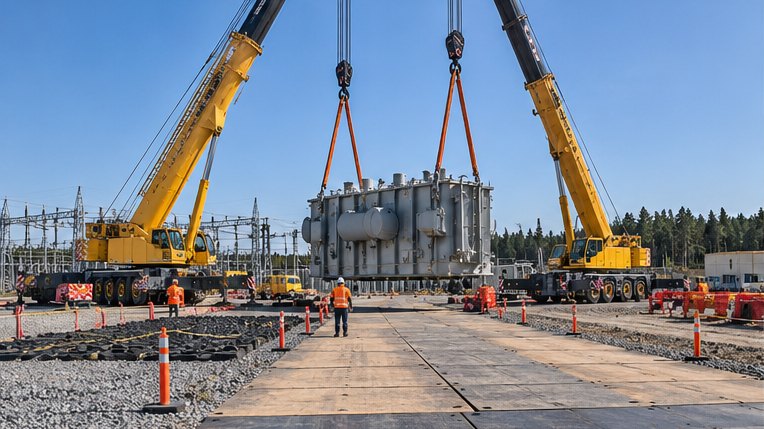
Figure: Heavy cranes and transport sites for transformers, wind and large-scale electrical equipment, with a focus on “how to judge damage to the surface pavement”
The site installation should be located with an approved drawing number, and the level, seam, edge and drainage should be inspected at each stage of completion. The area of the leg pad shall be determined by the maximum retroactivity in conjunction with the confirmed ground-based load, and the pavement shall not automatically replace the accounted hanger operating platform. The test operation can first be carried out using a low-risk vehicle with a slow-speed straight-line and then gradually verify the turnover, parking and full-loading; it should be discontinued as soon as it is discovered that it continues to sink under the plate, pump mud or branch position. The test-pail record of the “how to judge damage to the surface-painted pavement” should indicate the starting and ending position, the condition of the vehicle and the release conclusion, to facilitate review as the construction conditions change.
The mid-legged, full contact, mat deformation, deposition, horizontal, edge fracture, road stitches and transport wheel tracks shall be inspected during the operational period before class, after peak traffic and after rainfall. Each record shall contain the date, location, vehicle, weather, unusual photographs and processing results. In the event of a decline in ground-based loads following repeated rainfall in the same area and the emergence of pumping mud or faults, the ground, drainage, transport organization and specification should be re-analysed instead of replacing surface components. The inspection forms are designed to reduce the ground-based load after the rainfall and to alter the pump mud or the wrong table, and to indicate the time taken by the inspector and his/her return.
It is recommended that a key route or a feeder of equipment be selected for controlled validation, with observation cycles and exit conditions. The records cover normal and most unfavourable conditions, with particular attention to the decline in ground-based loads following rainfall and the emergence of pump muds or faults. A further expansion after the trial could reduce one-time procurement or full-line errors, while providing the same basis for vendor comparison. This retrodiscussion should also answer “how to judge ground protection mats damage” whether the improvement was verified by calculating the straight-line segment, the bend area, the docking position and the surface, respectively, so as to avoid a subjective description of the closing item.
This paper could serve as a technical discussion list for energy projects, but not as a separate construction permit. The project will also require a written programme of transport organization, temporary structures, electrical safety, fire protection, weather emergencies and site restoration systems, and a review of key carrying and stabilization conditions by authorized personnel.
Need for further evaluation of the actual project?
Applications, sizes, quantities, site photographs or drawings and delivery destinations are sent, on which we can identify more suitable products and processing programmes.







