
The objective of the acceptance of temporary roads for heavy transformer transport is to allow construction vehicles to travel within controlled routes, while avoiding turning ground protection issues into equipment stabilization problems. With regard to heavy cranes and transport sites around transformers, winders and large-scale electrical equipment, this topic is concerned with “how to receive and inspect temporary roads for transport of heavy transformers”, and should, in particular, check the decline in ground-based loads following rainfall and the emergence of pump muds or faults. Where there is a gutter, backfilling area, slope or unknown underground facility on the route, the treatment must first be confirmed by the responsible party of the project.
The focus of the topic is not on the choice of the thickest or the most heavy products, but on the establishment of a match. The coverage, connection and back-up quantities are determined by calculating the direct-line segment, the turn-off area, the docking position and the operating surface, respectively, on the basis of the maximum retroactivity of the plant ' s leg, the position of the leg, the ground-based allowance for pressure, the distance of the gutter from the edge, the suspension radius, the transport axle and the control of rainfall variability. In the case of products requiring cross-project turnaround, the numbering, loss rate, cleaning time and volume of transport should also be included in the total cost. For “how to receive and inspect temporary roads for the transport of heavy transformers”, the information review should also draw out the protection and restoration of the boundary of topsoil, ploughing or grassland and include missing information as an item to be confirmed for the quotation and construction programme.
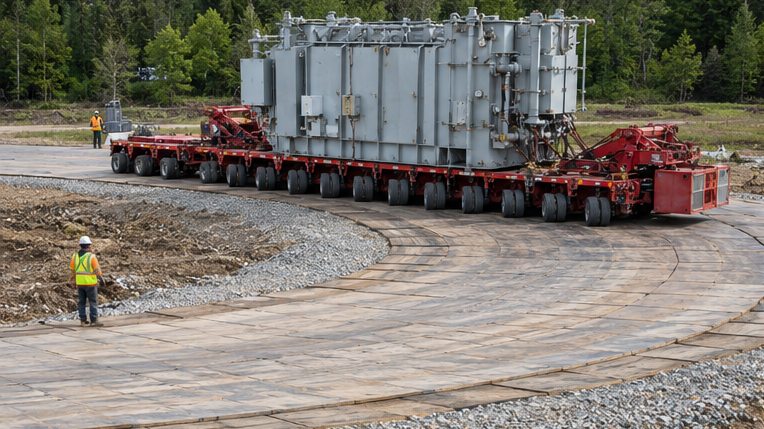
Figure: Heavy cranes and transport sites for transformers, wind and large power, with a focus on “How to accept temporary roads for transport of heavy transformers”
The drainage direction, soft spots and support under the plate should be compared before and after the rainfall, and the water should not be enclosed under the plate. The area of the leg pad shall be determined by the maximum retroactivity in conjunction with the confirmed ground-based load, and the pavement shall not automatically replace the accounted hanger operating platform. If the ground-based load drops after the rainfall and the pump mud or the wrong table is already present, the area should be sealed, the lifting plate should be treated for drainage and re-connected; the reason cannot normally be eliminated by cleaning the surface or adding a single sheet. The trial-padging record of “how to accept temporary road for the transport of heavy transformers” should identify the starting point, vehicle status and release conclusions to facilitate review as construction conditions change.
Special inspections should be added after extreme weather, equipment anomalies or route adjustments. The use of position signs and fixed view photographs for mid-legged, full-exposure, mat deformation, sedimentation, horizontality, edge fractures, road stitches and transport wheels facilitates comparison of deposition and shift. Cleaning the surface of polymers avoids fire, sharp shovels and violent knocks, creating new cracks and stress concentrations. For “how to receive and inspect temporary roads for transport of heavy transformers”, the inspection forms are to show a separate line of ground-based loads reduced after rainfall and changes in pump mud or wrong table, with an indication of the inspector and the time of return.
The offers from different suppliers should be compared under the same size, material, connection, packaging, delivery and test basis. Supplementation should be requested if the maximum load is given without a description of the ground, distance and load. Energy projects should also focus on batch consistency, port efficiency, repairability and container loading. It should also answer whether the “how to accept the temporary road for the transport of heavy transformers” has been shown to be an improvement by calculating the straight-line segment, the bend area, the docking position and the surface, so as to avoid a subjective description of the final item.
Road-painting and foot mats can only function in the approved construction system and cannot be a substitute for unsatisfactory foundations, damaged equipment or irregularities. Any unknown underground facility, unstable edges, legwork beyond the equipment manual or failure to isolate persons should be suspended and upgraded.
Need for further evaluation of the actual project?
Applications, sizes, quantities, site photographs or drawings and delivery destinations are sent, on which we can identify more suitable products and processing programmes.







