
The preparation before laying tends to determine road performance more than the paving exercise itself. The construction area should first be closed to identify the risk of underground pipelines, trenches, backfilling areas and slopes, and then remove sharp stones, steel bars, stakes and miscellaneous items that may be on top of the plate and treat the obvious high and deep. Water catchment areas need to identify sources of water and to arrange for drainage, and must not be covered directly by slabs on moving slurry. For very soft foundations, the ground floor can be continuously supported by the addition of earthpapers, grids or grade ingredients under the engineering programme.
The opening shall mark the centre of the road, the boundary, the turning zone and the car section and confirm the width and safety of the vehicle. The laying usually moves from hardened roads or other stable starting points to soft areas, where transportation and installation will always work on completed roads. The direction of the plate is to be matched with the direction of the vehicle, the texture design and the connection hole; there should be no significant high difference between the adjacent plates. The required lifting or mechanical tools are used to prevent personnel from putting their hands and feet under the suspension.
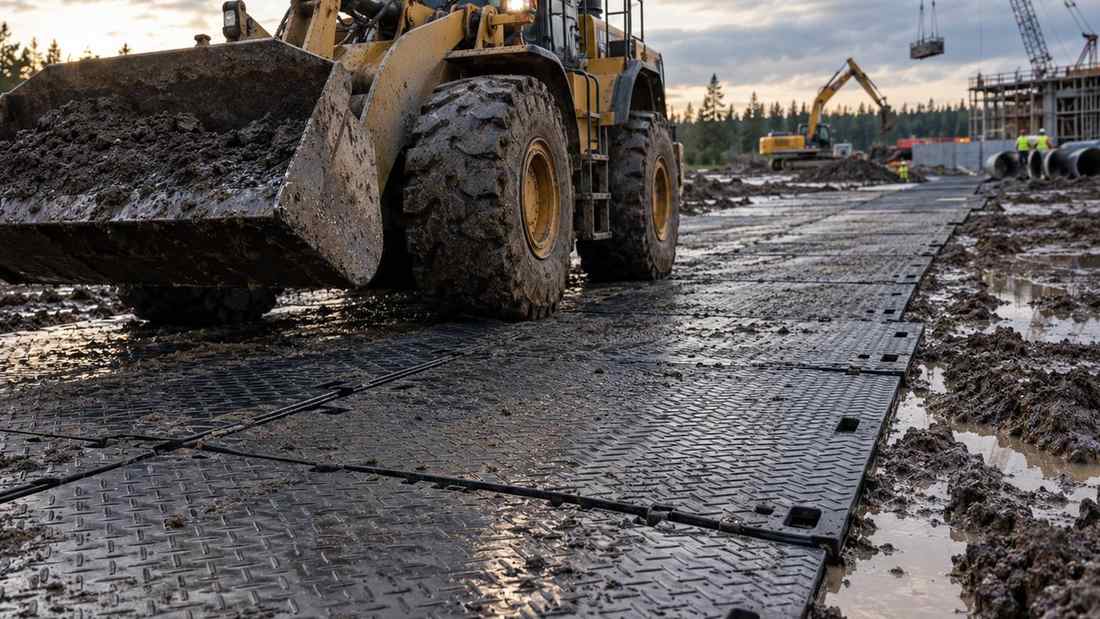
Web site mapping: pavement board application in muddy construction areas
Connectors serve to maintain a relative position between plates and reduce the separation caused by vehicle turns, brakes, ramps or mudslides. It is not an annex that can be omitted from any scene, nor can it be loaded to resist all side forces. Short distance, solid flat, low-speed straight and non-shifting plates can be determined by the project leader on the basis of the product description; soft land, long roads, bends, ramps and HF reloads usually require more complete connectivity. No force may be imposed if the connection hole has been damaged.
When laid, empty and stage-by-stage tests should be carried out to observe whether the plates are plumbing, slide, fall down or cause an abnormal breakout, and to check that the vehicle tyres remain in the design corridor. The first heavy vehicles are to be reviewed for connection and base level after adoption, and re-checked after rain, after freezing or after excavated disturbance of the ground. Clearing the sutures avoids slabs crushing each other; ground-based pump mud is found and should be repaired at the grass-roots level instead of tightening the links.
Dismantling takes place on a sector-by-section basis, and is cleaned, checked and sorted and stacked. The project document should record the date of installation, the section, the plate batch, the number of connectors, the inspection and the unusual handling, so as to facilitate the next tracking. When asking for a price or setting up an installation programme, please provide a road map, type of ground, slope, vehicle movement and existing pavement equipment before the supplier can recommend the form, quantity and installation tools of the connection. On-site operations will still be subject to the project ' s traffic management and lifting and handling requirements.
Need for further evaluation of the actual project?
Applications, sizes, quantities, site photographs or drawings and delivery destinations are sent, on which we can identify more suitable products and processing programmes.







