
The primary task of the leg pads is to spread the central reaction of the footpads to a larger surface area so that the average pressure on the ground remains within acceptable limits. The rationale is to divide the maximum retroactivity of the leg under the most unfavourable conditions of work by the ground allowed to carry the pressure, and to obtain the minimum exposure area required, combined with the safety factor, the rigidity of the mattress and the unevenness of the site. The force of the leg rather than the weight of the whole equipment was used in the calculations; the ground allowed pressure should also come from the site survey, engineering judgement or project regulation, rather than from the naked eye.
For example, if, by means of equipment information or suspension, a particular leg has a force of 200 kC and the ground is allowed to contain 100 kPa, the theoretical area of a simple average pressure is approximately 2 m2. This result has not taken into account eccentricity, edge warp, mollusc thickness, curvature of the pad itself and safety residuals and cannot be used as a direct final specification. If there are trenches, basements, pipes or near-term backfills beneath the ground, even if the surface is hard, there may be a need for greater pressure systems or specialized engineering.
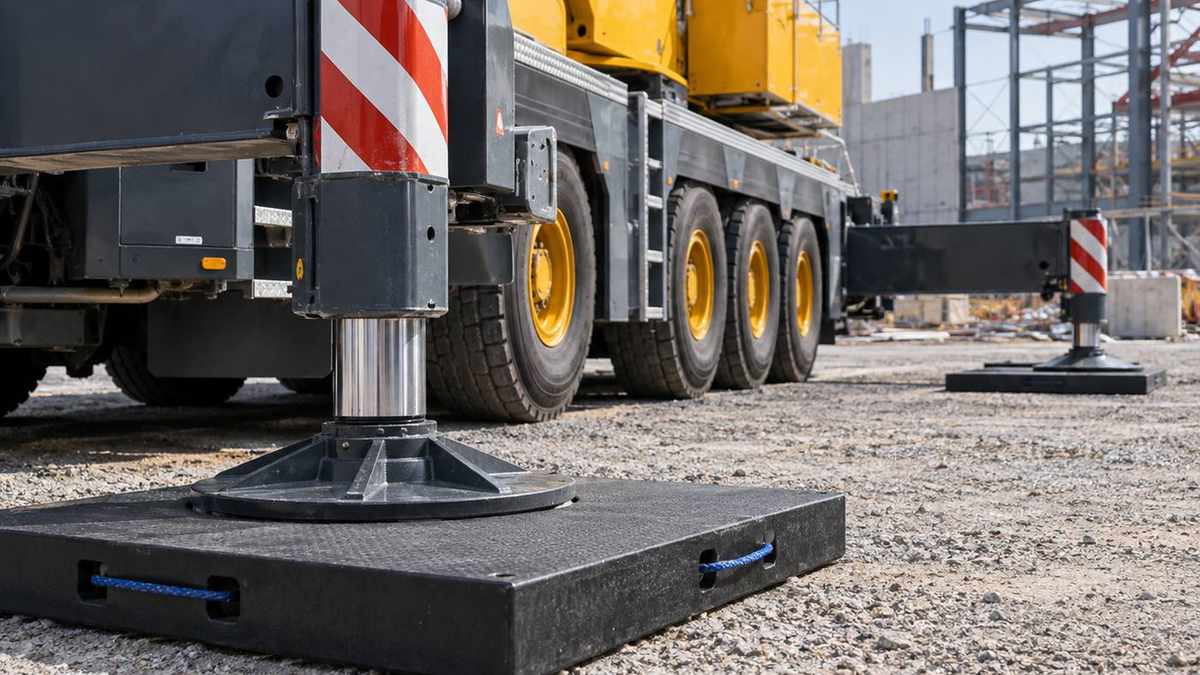
Web site mapping: live application of mobile crane leg pads
The thickness determines the resistance and resistance of the pads to the load between the legs and the ground, provided that the area and thickness are designed together. Large, but thin, pads can create clear bends, resulting in an effective stress range of less than the outer area; they are thick but insufficient and still give rise to excessive pressure on the ground. It is also necessary to confirm the size of the foot plate, the balance of the edge of the pad, the position of the handle or hanger, and to ensure that the line of action for the leg is as far as possible at the centre of the pad and cannot be pressed near the edge or the connecting hole.
Large liftings are sometimes supported by wood, steel plates, composite pads or multilayer systems. Multilayering is not a simple addition, and inter-layer slides, thrust and integrity of exposure must be designed by qualified personnel. Plastic leg mats should not cross empty holes, nor should they be placed on loose groceries, slopes or ice to bear a direct high reaction. The landing of legs and the deformation of pads should be monitored during the lifting process before the operation, and should be stopped immediately and reassessed in the event of continuous sinking, cracking, slippage or deviation of legs from the centre.
When asking the supplier for price, please provide the crane type, maximum retroactivity of the leg or associated load table, the size of the disc, the retour and direction of the laden, the ground report, the duration of the operation, the ambient temperature and handling restrictions. If only the total weight of the equipment is obtained, the retrogression of the leg should be obtained first from the equipment manufacturer or the suspension engineer. The supplier may recommend materials, sizes, thickness, hand lifting and marking on this basis, but the final support programme should be included in the formal suspension plan and approved by the responsible person on the ground.
Need for further evaluation of the actual project?
Applications, sizes, quantities, site photographs or drawings and delivery destinations are sent, on which we can identify more suitable products and processing programmes.







